Most perceptions surrounding grid instability in the Philippines begin with brownouts. The scheduled ones, the unscheduled ones, the ones that last twenty minutes and the ones that last four hours. Brownouts are visible and disruptive and easy to see and experience.
But the grid instability that causes the most cumulative damage to Philippine businesses is not the outage. It is everything that happens surrounding it.
The ten minutes before power fails, when voltage is sagging and fluctuating as the utility struggles to balance supply and demand. The surge when supply is restored and every motor, compressor, and controller on the network tries to restart simultaneously. The frequency shift that occurs when large generation units go offline unexpectedly. The chronic low-voltage conditions that persist for hours in areas at the end of long distribution lines, not bad enough to trigger a formal interruption but bad enough to stress equipment continuously.
These are the grid conditions that Philippine businesses actually live with. And they inevitably vary enormously depending on where you are.
Geography Determines Your Grid Reality
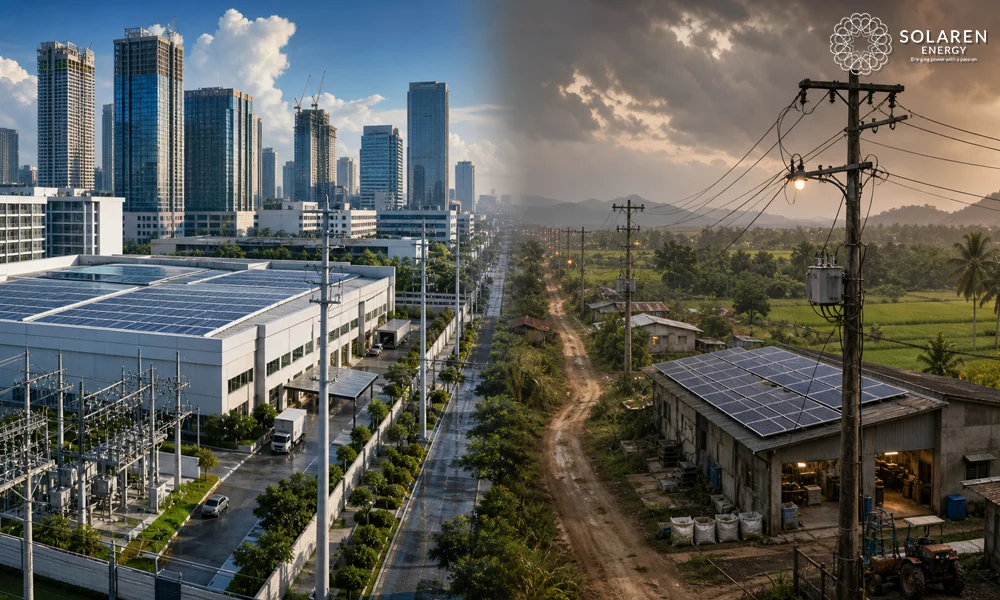
This is something most solar quotations do not address and most buyers do not think to ask about.
The largest distribution utility in the country, serving Metro Manila and surrounding provinces, generally delivers a more stable supply than provincial cooperatives. Urban density, infrastructure investment, and network redundancy affords it resilience that smaller distribution systems simply cannot match. That does not mean it is problem-free. Certain areas within its coverage zone experience localized instability driven by network loading, aging infrastructure, or proximity to large industrial loads. But as a rule, a business in its service area starts from a more stable baseline than one served by a typical smaller cooperative.
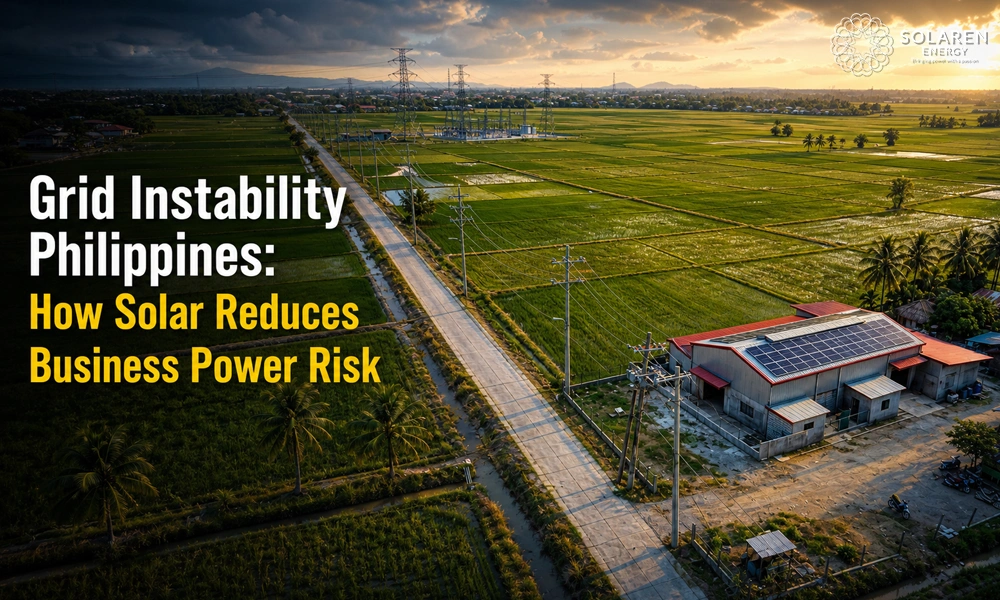
Move outside that zone and the scene changes considerably. Rural cooperatives serving agricultural provinces often operate aging infrastructure with limited or zero redundancy. Long single-feed distribution lines mean a fault anywhere upstream affects everything downstream. Voltage at the end of a ten-kilometer feeder during peak demand hours can be meaningfully lower than at the source. The metered voltage at your distribution board may be within acceptable limits on paper, while the actual supply quality is causing equipment to underperform and degrade.
This geographic reality is why solar system specifications are not interchangeable. An inverter specified for the relatively stable conditions of an urban Metro Manila installation will almost certainly trip more frequently on a provincial site where voltage wanders outside a narrower tolerance window. A system designed without accounting for local grid characteristics will underperform against its simulation from day one, and the cost of the production gap will compound over the years.
What Instability Actually Does to a Business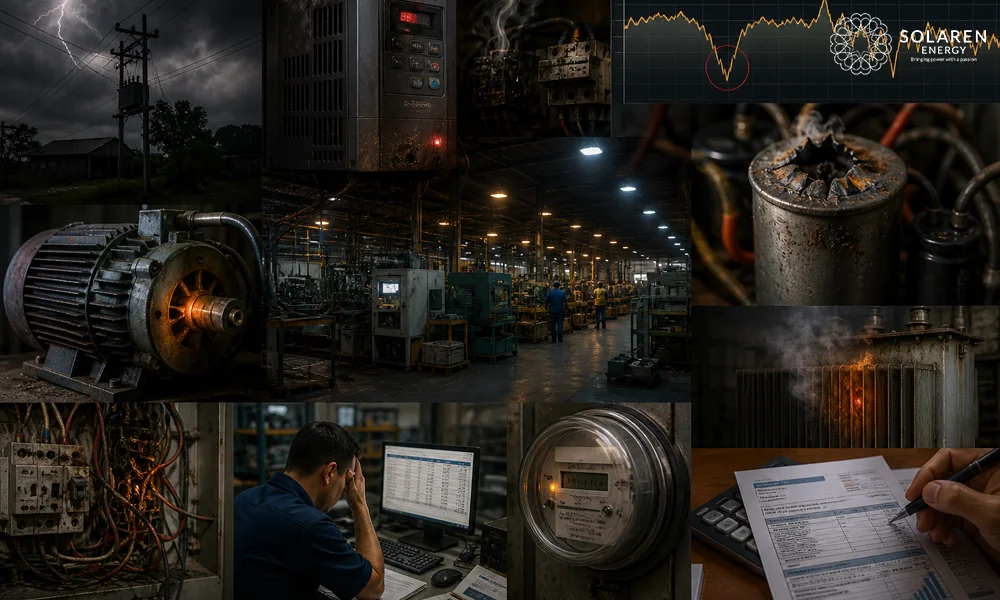
The obvious costs are lost production during outages. The less obvious costs are the ones that accumulate between outages, silently and continuously.
Equipment that operates near the edge of its voltage tolerance for extended periods degrades faster than its nameplate rating suggests it should. Variable speed drives, PLCs, and motor control systems that experience repeated voltage sags and swells develop faults that appear to be random because nobody is logging the supply conditions that precede them. Capacitor banks fail ahead of schedule. Transformers run hot. Neutral cables carry currents they were never sized for because harmonic loading from the facility’s own non-linear loads is compounding the problem.
Meanwhile, the electricity bill reflects a power factor that the facility manager may not even be aware of. In some tariff structures, the power factor penalty is a visible surcharge. In others it is embedded in the billing calculation invisibly. Either way, a facility running a poor power factor is paying for electricity that does no useful work, and that cost is proportional to the severity of the inductive load.
None of this is caused by solar. But solar changes the equation in ways that address several of these problems simultaneously, particularly when the system is correctly specified for local grid conditions.
How Solar Changes the Grid Relationship
A grid-tied solar system reduces how much current a facility draws from the utility during daylight hours. That reduction has consequences beyond the obvious one of lowering the bill.
When a facility draws less from the grid, it is less exposed to the voltage instability that travels through the distribution network from neighboring loads. A factory drawing 200kW from a cooperative feeder that is carrying 800kW of total load experiences different voltage conditions from one drawing only 80kW because solar is covering the rest. The grid-side disturbances are still there. The facility is simply less affected by them because its exposure is smaller.
Power factor correction, when integrated into the solar design at the outset rather than added as an afterthought, addresses the inductive load problem at the same time. The capacitor bank improves the facility’s power factor, reduces the current drawn from the grid, and eliminates penalty charges that were previously invisible in the bill. On a facility with significant motor loads running continuously, the power factor correction payback can very easily be shorter than the solar payback.
Surge protection at the inverter input and the distribution board interface addresses the restoration surge problem specifically. Every time the grid returns after an outage, a correctly protected solar installation manages the reconnection in a way that does not expose sensitive equipment to the transient overvoltage that an unprotected system would see. This is a design decision, not a standard feature. Specifying it correctly requires understanding the grid environment the facility system is operating.
The Hybrid Addition
Grid-tied solar addresses the grid relationship during normal operation. It does not address outages. When the grid fails, a grid-tied inverter disconnects for safety reasons and generation stops.
For facilities where the cost of an interruption is significant, a hybrid system with battery storage changes the picture. The inverter switches to stored energy in milliseconds. Priority loads keep running. The grid can do what it needs to do.
But the battery in a commercial hybrid system also does something else that is relevant to grid instability, specifically. It acts as a buffer between the facility and the grid during the unstable periods around an outage. When the battery is supplying the load, the facility is electrically isolated from the grid disturbances that precede and follow an interruption. The voltage sag that trips the packaging line on a grid-tied site does not reach the load on a hybrid site with a correctly configured battery system.
This buffering effect is underappreciated in most commercial solar proposals because it is harder to quantify than avoided outage costs. But for a food manufacturer with a spoilage problem driven by repeated brief interruptions, or an industrial facility with a VFD failure history that correlates with cooperative grid events, it can be the most valuable function the storage system performs.
Designing for the Grid You Actually Have
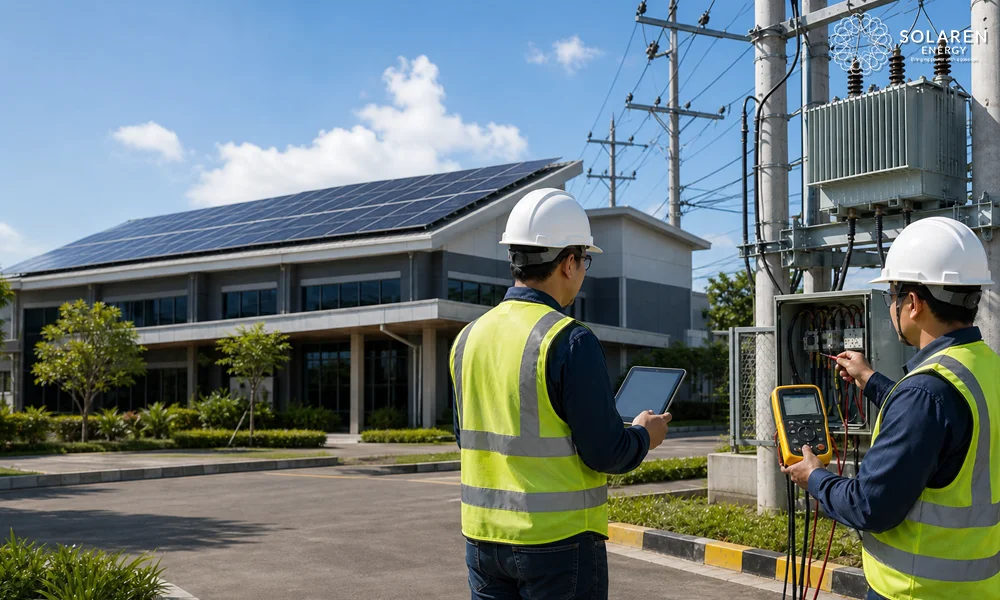
The practical implication of all of this is that solar system design should start with a genuine assessment of the grid environment the system will operate in, not a generic simulation run against standard irradiance data.
What is the distribution utility and what are its documented performance characteristics in this area? What does voltage and frequency actually look like at the facility’s incoming supply across different times of day and different seasons? What harmonic loading does the facility itself introduce into the system? What are the restoration surge characteristics when the grid returns after an outage?
These questions require measurement and local knowledge, not assumptions. An EPC that has worked extensively in the area understands the grid conditions from experience. One that has not will apply a generic design that may perform well in its simulation and less well in practice.
Solaren has installed commercial and industrial systems across Luzon, Visayas, and Mindanao, in Meralco zones and in provincial cooperative service areas. The inverter specifications, protection configurations, and cable sizing decisions on those sites reflect actual local grid conditions, not theoretical ones. That difference shows up in the generation data over the years, not in the initial proposal comparison.
For the broader financial case for solar against the backdrop of rising electricity costs and increasing supply volatility, The Ultimate Guide to Commercial Solar ROI in the Philippines gives the framework for evaluating any commercial solar investment properly. And for businesses where power quality problems are a known cost, the Top 5 Power Quality Problems in Philippine Factories covers the diagnostic and remediation approach in detail.
Frequently Asked Questions

-
Does my solar system need to be designed differently depending on which distribution utility serves my area?
Yes, meaningfully so. Inverter voltage and frequency tolerance ranges, surge protection specifications, and grid interface design should all reflect the actual supply characteristics of your location. A system specified for stable urban grid conditions might trip more frequently on a provincial cooperative feeder where voltage varies outside a narrower window. Ask your contractor specifically how their design accounts for your local grid conditions and what measurements or local experience inform that specification.
-
Can solar actually reduce equipment damage from power quality problems?
Directly, in some cases. A hybrid system with battery storage buffers priority loads from the voltage disturbances that precede and follow grid outages, which are the periods of greatest damage risk. Power factor correction integrated into the solar design reduces the reactive current circulating in the facility’s own electrical system, which reduces transformer heating and neutral conductor loading. Surge protection at the inverter interface manages restoration transients. None of these replaces a proper power quality assessment and remediation program, but they address several of the most common damage mechanisms simultaneously.
-
What is the most cost-effective first step for a business dealing with grid instability?
A power quality assessment. Install a logger on the incoming supply for two to four weeks and measure what is actually happening. That data tells you which problems are coming from the grid and which are generated within the facility itself, how severe they are, and what the likely cost impact is. It also gives you the information you need to specify a solar system correctly for your actual conditions rather than average assumptions. The assessment cost is modest. The decisions it informs are not.