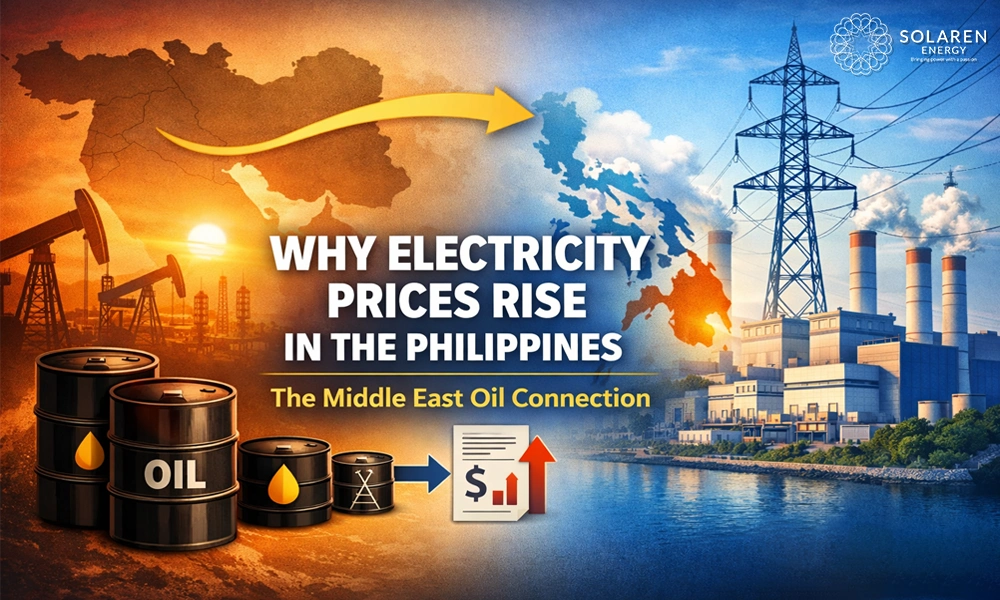
Right now, as conflict continues to disrupt energy supply routes in the Middle East, global oil prices are moving. That is expected. What catches most business owners off guard is what happens three months later, when they open their electricity bill and see a number that has nothing to do with how much power they actually used.
This is not a coincidence. There is a direct transmission mechanism that runs from a conflict in the Gulf straight to the generation charge on a Meralco bill, a provincial cooperative statement, or a bill from any distribution company in the country. Once you understand how it works, the volatility stops feeling random.

Global oil and LNG shipments pass through critical energy corridors such as the Strait of Hormuz, making energy markets highly sensitive to geopolitical disruptions.
Why Electricity Prices Rise in the Philippines
Roughly 75% to 80% of Philippine power plants run on coal, natural gas, and oil. The country imports the vast majority of these fuels. Coal arrives as thermal coal traded on global indices like the API4. Natural gas is delivered as LNG under contracts and in spot cargoes, priced against international benchmarks. Many people think Malampaya gas is cheaper. This is not true, as the price still follows the international pricing methodology. Other power sources, such as hydro, wind, and solar, have far more stable costs.
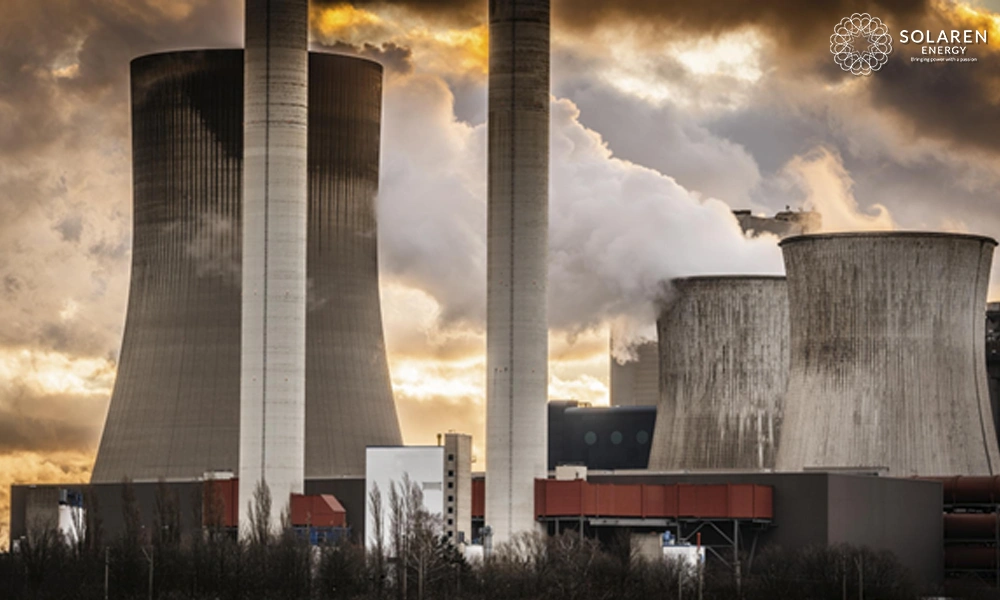
Roughly three quarters of Philippine electricity is still generated from coal, natural gas, and oil-based plants.
Virtually none of these prices is set in Manila. When a supply disruption, a shipping bottleneck, or a geopolitical shock causes those benchmarks to move, the cost to run a Philippine power plant moves with them. Power producers do not absorb that cost. It passes through the system.
The Philippine peso trades on international foreign exchange markets, which frequently worsens the problem because around 99 percent of Independent Power Producer (IPP) costs are denominated in US dollars.
So what is the result? The factors, a weaker peso, plus global energy price shocks, can accelerate and compound the local hit. Philippine electricity consumers face both forces simultaneously.
How The Cost Travels From Crude Oil To Your Monthly Bill
The path is not immediate. There is typically a delay of one to three months between a global fuel price move and its appearance in local tariffs. But the path is predictable:
- A supply shock or conflict raises global crude oil prices. LNG and thermal coal markets tend to follow each other, as they compete for the same energy demand and share overlapping shipping routes.
- Philippine power producers pay more for their fuel deliveries. Many fuel contracts are settled in dollars, so a weakening peso further increases the cost.
- Under Philippine electricity market rules, generation costs are pass-through charges. Power producers recover them from distribution utilities across the country through the wholesale market and contracted agreements.
- Distribution utilities pass those costs to consumers through the generation charge. This component typically makes up 50 to 60 percent of a commercial or industrial electricity bill. When it moves, the total bill moves substantially.
What makes this frustrating for consumers is the asymmetry. When fuel prices rise, the effect filters through quickly. When they fall, the adjustment takes much longer to work its way back down through contracts, settlements, and billing cycles.
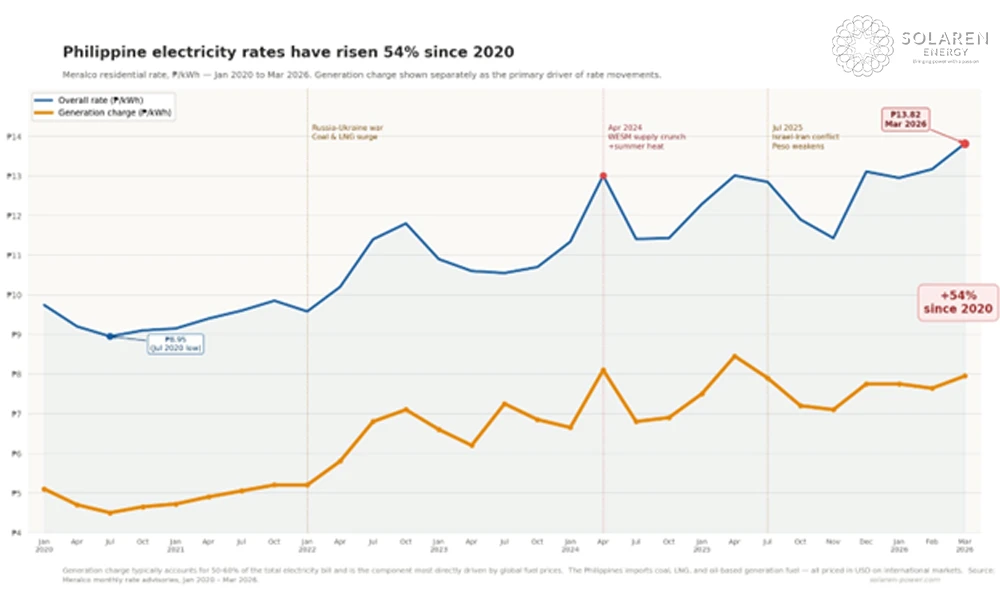
Philippine electricity rates have increased more than 50% since 2020, with major spikes following global energy shocks such as the Russia-Ukraine war and the Middle East conflict.
Not Every Business Faces The Same Exposure
The degree of exposure depends partly on which distribution utility supplies the site and how that utility sources its power. Cooperatives that depend heavily on the Wholesale Electricity Spot Market for a large share of their supply are the most vulnerable. When spot prices spike, which they do reliably during periods of fuel cost stress, those consumers bear the full effect without the protection of long-term contracted supply at fixed rates.
Electricity rates in some provincial areas of the Philippines have at times reached ₱17 to ₱18 per kWh, well above the national average, precisely because of this exposure. High-consumption businesses in those areas feel every global fuel movement more acutely than businesses connected to utilities with a more diversified generation mix.
For any energy-intensive operation, this is worth understanding. The electricity rate on last month’s bill is not a fixed number. It reflects decisions made by power producers, commodity traders, and governments in markets far removed from the business itself.
Poultry Farms: Why The Exposure Is Acute
Of all the business types that feel electricity price shocks quickly and sharply, poultry operations sit near the top of the list. The reason is clear: the loads that keep a chicken house functional run continuously during the day.
Ventilation fans cycle without stopping to maintain air quality and temperature. Cooling pads keep barn conditions within the tight thermal range that determines feed conversion and bird health. Lighting follows managed schedules that run through daylight hours. For a mid-sized broiler or layer operation, electricity is not a background cost. It is one of the primary inputs, on par with feed.
There is also a margin problem. Poultry producers sell into markets where farmgate prices move on their own cycle, driven by supply, demand, and competition. When electricity costs jump due to an oil shock in the Gulf, there is no mechanism to immediately pass that increase to the buyer. The farm absorbs it. Over a quarter or two, that compression adds up.
The farms that have moved to lock in a portion of their electricity cost through solar generation have effectively removed one variable from an already tight margin structure. That is a meaningful operational improvement, regardless of what happens to global fuel markets in any given month.
A Tarlac Poultry Operation Makes The Numbers Concrete
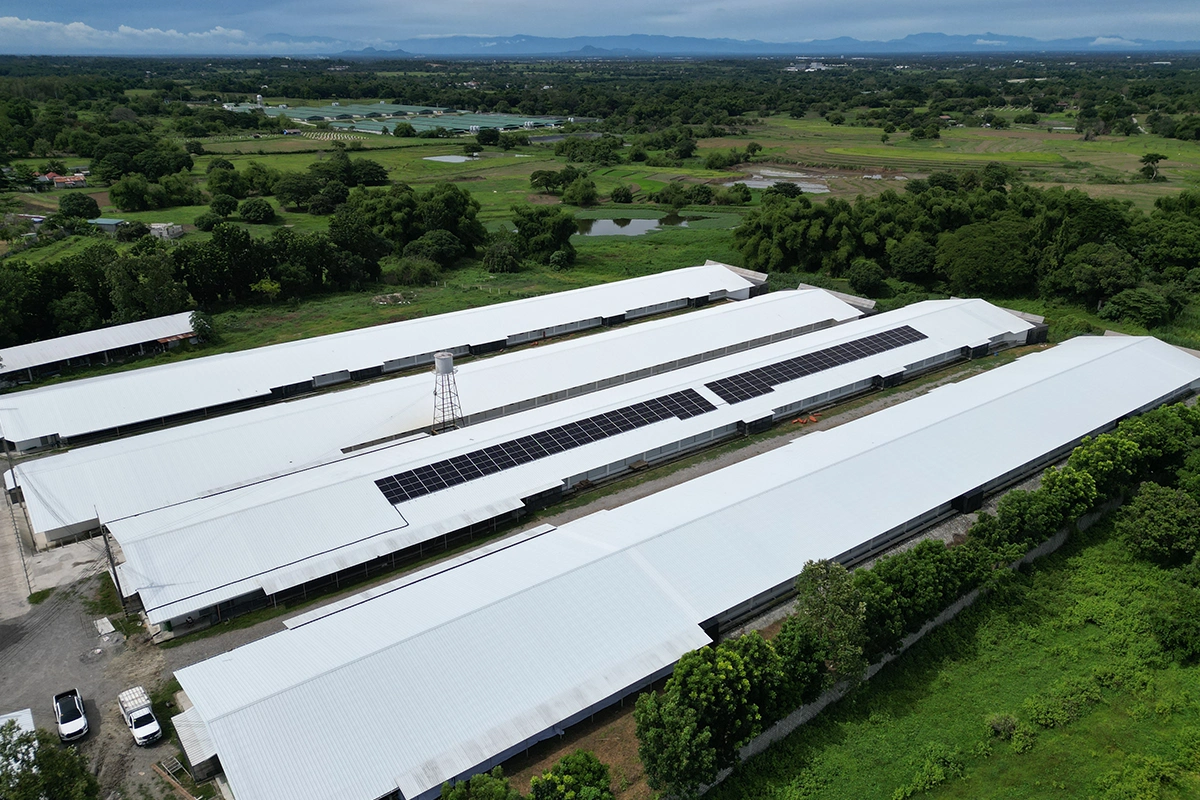
Tañedo Poultry Farm in San Jose, Tarlac, is part of a larger operation that has been rolling out solar across multiple farm sites in the province. The San Jose installation, completed in July 2024 and connected to the Tarelco grid, is a 99.75 kWp system sized to match the farm’s daytime peak load of approximately 85 kW.
The design was easy. Fans, cooling pads, and lighting drive the farm’s daytime consumption. That load profile lines up well with solar output, so the system does not need battery storage to be effective. It produces power when the farm needs it most, cutting the midday bill while net metering captures any surplus generation as credit.
The system’s annual generation is approximately 147,131 kWh. In practical terms, that is equivalent to taking a substantial portion of the farm’s electricity consumption off the grid for the duration of a full year, every year, for the life of the system.
The financial results: daily savings of ₱4,496, monthly savings of approximately ₱134,870, and annual savings of over ₱1.6 million. Projected lifetime savings exceed ₱41 million. Payback period: 4.1 years.
The payback period here is slightly longer than for a commercial building because the farm’s electricity rate, while meaningful, is not at the extreme end of the provincial rate spectrum. But the logic holds in the same direction. If fuel prices rise and the local rate rises in step, the payback shortens. The savings grow. The hedge becomes more valuable, not less.
View the Tanedo Poultry Farm project details.
A Hardware Business In Naga City Tells A Similar Story
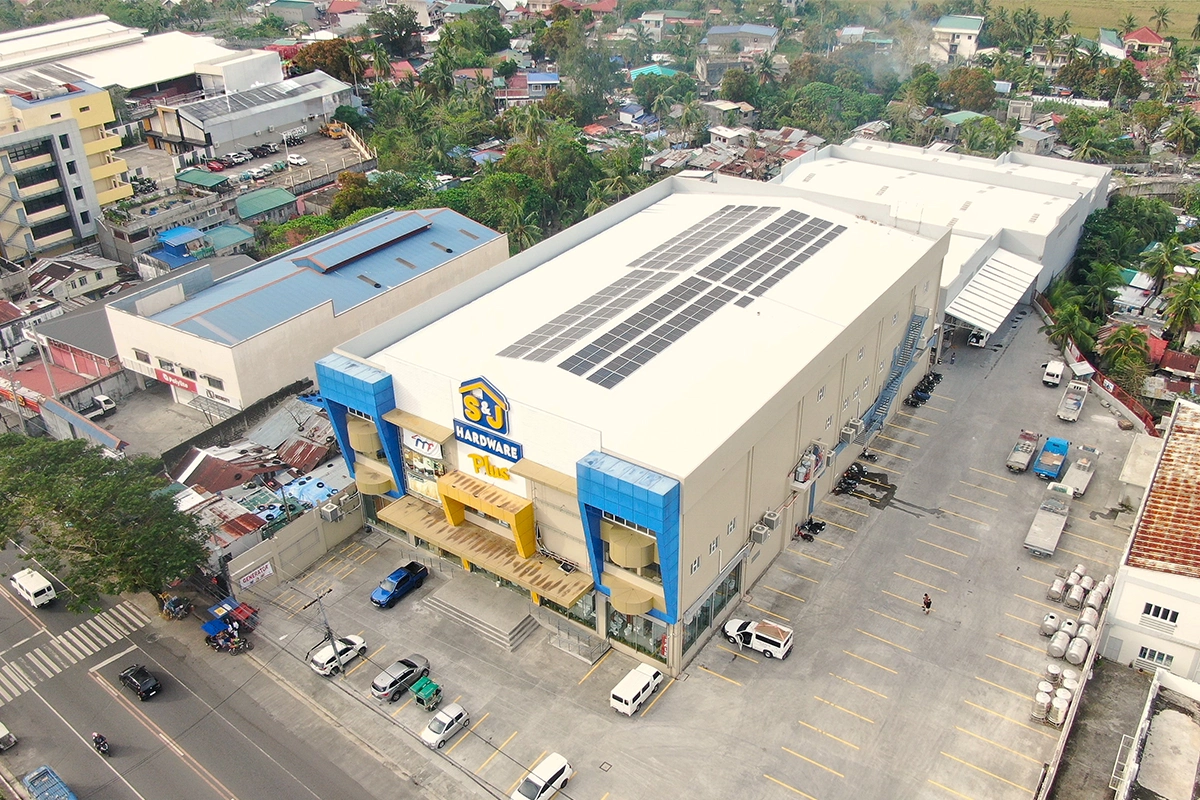
S&J Hardware Plus, a retail and warehouse operation in Naga City, invested in a 99.98 kWp rooftop solar system completed in December 2025. Naga City electricity rates have historically been above the national average, which strengthened the case for solar and accelerated payback.
The system generates approximately 147,471 kWh per year. Because solar carries no fuel cost (the panels produce electricity whether crude oil is at $70 or $120 per barrel), the portion of the facility’s consumption met by solar is completely decoupled from global energy market movements.
The financial results: daily savings of ₱4,506, monthly savings of approximately ₱135,000, and annual savings of over ₱1.6 million. Projected lifetime savings exceed ₱41 million. Payback period: 2.8 years.
Two businesses in different sectors and different provinces. Both running systems are of equivalent size. Both generate similar annual savings. The difference in payback periods reflects differences in local electricity rates. The underlying logic is identical: fix a portion of your energy cost today, and stop paying whatever the global fuel market decides to charge tomorrow.
View the S&J Hardware Plus project details
Solar Does Not Eliminate The Grid. It Reduces Your Exposure To It
This is an important distinction. A commercial solar system installed alongside a grid supply does not make a business energy independent. The grid remains available for evening demand, cloudy periods, and load above the system’s output. What the solar system does is offset a significant share of the daytime consumption that would otherwise be billed at the prevailing generation charge rate.
Think of it as a partial hedge. Every kilowatt-hour the panels produce is one that the distribution utility does not bill. When the generation charge rises because crude oil climbed on news from the Gulf, the business is insulated from that portion of its consumption. The cost exposure remains, but it is smaller.
For businesses with high daytime loads: manufacturing facilities, warehouses, cold storage operations, and commercial buildings. The offset can be substantial. The alignment between solar generation hours and typical commercial operating hours is one of the reasons the economics work as well as they do.
The Double Benefit: Lower Costs And A Hedge Against Future Shocks
Most investment analyses for commercial solar focus on the immediate cost reduction. The savings versus the current bill are real, measurable, and typically deliver payback within three to five years.
But the more durable argument is the hedge. Solar has a fixed cost structure: the system is built, and then it runs. There are no fuel purchases, no exposure to shipping costs, and no sensitivity to peso depreciation against the dollar. The cost per kWh of solar output is determined on the day the system is financed, not on the day crude oil spikes in reaction to news from Hormuz.
Businesses that installed commercial solar in 2022 or 2023 were largely unaffected by the generation charge increases that followed the Israel-Iran escalation in mid-2025. That insulation was not accidental. It was a structural consequence of generating electricity from a fuel-free source.
The question for any energy-intensive business in the Philippines is not whether global energy markets will remain volatile. They will. The question is how much of that volatility the business chooses to absorb.
What This Means For Long-term Planning
Electricity has traditionally been treated as a fixed operating cost, something that rises a little each year but remains broadly predictable. That assumption no longer holds for Philippine commercial and industrial consumers.
The generation charge is the largest and most volatile component of the bill. It moves in response to global commodity markets, exchange rate movements, and international events that business owners cannot predict or control. A poultry farm in Tarlac, a factory in Laguna, a hardware business in Naga City: all of them are exposed to decisions made by traders in London and decision-makers in Washington and Riyadh.
The businesses that are managing this well are treating energy not as a utility bill but as an operating exposure that can be structured and partially hedged. Solar is the most accessible tool for doing that at a commercial scale, but it is included in a broader question: what share of your electricity consumption do you want to be insulated from global fuel markets?
That question is worth answering before the next oil shock makes it urgent.
Further Reading
- Tanedo Poultry Farm: Tarlac solar project
- S&J Hardware Plus: Naga City solar project
- Solaren commercial solar projects
- Meralco July 2025 rate advisory (Israel-Iran conflict impact)
Solaren Renewable Energy Solutions Corp. is a DOE-accredited commercial and industrial solar EPC contractor with over 85MW of installed capacity across the Philippines, founded in 2014 and headquartered in Tarlac.
{
“@context”: “https://schema.org”,
“@graph”: [
{
“@type”: “Organization”,
“@id”: “https://solaren-power.com/#organization”,
“name”: “Solaren Renewable Energy Solutions Corp.”,
“url”: “https://solaren-power.com/”,
“email”: “sales@solaren-power.com”,
“telephone”: “+63 917 879 6037”,
“contactPoint”: [
{
“@type”: “ContactPoint”,
“contactType”: “sales”,
“telephone”: “+63 917 879 6037”,
“email”: “sales@solaren-power.com”,
“areaServed”: “PH”,
“availableLanguage”: [
“en”
]
}
],
“sameAs”: [
“https://solaren-power.com/”
]
},
{
“@type”: “WebSite”,
“@id”: “https://solaren-power.com/#website”,
“url”: “https://solaren-power.com/”,
“name”: “Solaren Power”,
“publisher”: {
“@id”: “https://solaren-power.com/#organization”
},
“inLanguage”: “en-PH”
},
{
“@type”: “WebPage”,
“@id”: “https://solaren-power.com/why-electricity-prices-rise-in-the-philippines/#webpage”,
“url”: “https://solaren-power.com/why-electricity-prices-rise-in-the-philippines/”,
“name”: “Why Electricity Prices Rise in the Philippines”,
“isPartOf”: {
“@id”: “https://solaren-power.com/#website”
},
“about”: {
“@id”: “https://solaren-power.com/why-electricity-prices-rise-in-the-philippines/#article”
},
“primaryImageOfPage”: {
“@id”: “https://solaren-power.com/why-electricity-prices-rise-in-the-philippines/#primaryimage”
},
“breadcrumb”: {
“@id”: “https://solaren-power.com/why-electricity-prices-rise-in-the-philippines/#breadcrumb”
},
“inLanguage”: “en-PH”
},
{
“@type”: “ImageObject”,
“@id”: “https://solaren-power.com/why-electricity-prices-rise-in-the-philippines/#primaryimage”,
“url”: “https://solaren-power.com/wp-content/uploads/2026/03/why-electricity-prices-rise-in-the-philippines.jpg”,
“contentUrl”: “https://solaren-power.com/wp-content/uploads/2026/03/why-electricity-prices-rise-in-the-philippines.jpg”,
“caption”: “Why Electricity Prices Rise in the Philippines”
},
{
“@type”: “BreadcrumbList”,
“@id”: “https://solaren-power.com/why-electricity-prices-rise-in-the-philippines/#breadcrumb”,
“itemListElement”: [
{
“@type”: “ListItem”,
“position”: 1,
“name”: “Home”,
“item”: “https://solaren-power.com/”
},
{
“@type”: “ListItem”,
“position”: 2,
“name”: “Blogs”,
“item”: “https://solaren-power.com/blogs/”
},
{
“@type”: “ListItem”,
“position”: 3,
“name”: “Why Electricity Prices Rise in the Philippines”,
“item”: “https://solaren-power.com/why-electricity-prices-rise-in-the-philippines/”
}
]
},
{
“@type”: “BlogPosting”,
“@id”: “https://solaren-power.com/why-electricity-prices-rise-in-the-philippines/#article”,
“mainEntityOfPage”: {
“@id”: “https://solaren-power.com/why-electricity-prices-rise-in-the-philippines/#webpage”
},
“headline”: “Why Electricity Prices Rise in the Philippines”,
“alternativeHeadline”: “Why Electricity Prices Rise in the Philippines: The Middle East Oil Connection”,
“description”: “An in-depth explanation of why electricity prices in the Philippines rise when global oil, LNG, and coal markets move, and how solar energy helps businesses reduce exposure to price shocks.”,
“image”: {
“@id”: “https://solaren-power.com/why-electricity-prices-rise-in-the-philippines/#primaryimage”
},
“author”: {
“@type”: “Organization”,
“@id”: “https://solaren-power.com/#organization”
},
“publisher”: {
“@id”: “https://solaren-power.com/#organization”
},
“articleSection”: “Energy Insights”,
“keywords”: [
“electricity prices Philippines”,
“why electricity prices rise in the Philippines”,
“Philippines power rates”,
“generation charge Philippines”,
“fuel price volatility Philippines”,
“solar energy Philippines”,
“Meralco bill generation charge”,
“energy price shocks Philippines”
],
“inLanguage”: “en-PH”,
“about”: [
{
“@type”: “Thing”,
“name”: “Electricity prices in the Philippines”
},
{
“@type”: “Thing”,
“name”: “Generation charge”
},
{
“@type”: “Thing”,
“name”: “Imported fuel dependence”
},
{
“@type”: “Thing”,
“name”: “Coal prices”
},
{
“@type”: “Thing”,
“name”: “LNG prices”
},
{
“@type”: “Thing”,
“name”: “Energy price volatility”
},
{
“@type”: “Thing”,
“name”: “Commercial solar energy”
}
],
“mentions”: [
{
“@type”: “Place”,
“name”: “Philippines”
},
{
“@type”: “Thing”,
“name”: “Middle East”
},
{
“@type”: “Thing”,
“name”: “Oil prices”
},
{
“@type”: “Thing”,
“name”: “LNG”
},
{
“@type”: “Thing”,
“name”: “Coal”
},
{
“@type”: “Thing”,
“name”: “Meralco”
}
],
“isPartOf”: {
“@id”: “https://solaren-power.com/#website”
},
“wordCount”: 1800,
“genre”: [
“Energy Analysis”,
“Business Education”,
“Solar Insights”
]
}
]
}