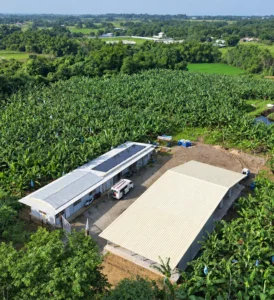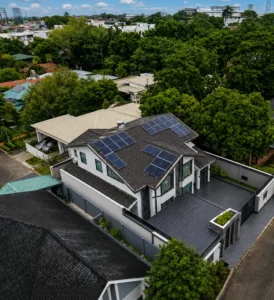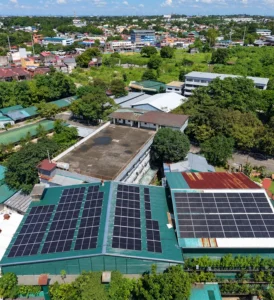
Energy storage solutions turn daytime solar gains into steady power through the night. By placing battery capacity next to solar installations, firms cut grid imports during peak hours and keep lights on during outages. Rising generation charges and frequent voltage dips push more business owners to store their own energy. A well-sized bank paired with commercial solar energy systems can trim monthly bills by 30 to 60 percent and lift overall return on investment.
Define your goal first

Before committing to a storage system, be clear about what you need it to do. Some businesses want backup power to keep critical operations running when the grid goes down. Others want to store solar energy during the day and use it at night when rates are higher. Many manufacturing and commercial clients use storage specifically for demand control, where the battery flattens consumption peaks and cuts utility demand charges.
Each purpose leads to a different design. The battery type, capacity, and operating logic all depend on your primary objective. Getting this wrong at the planning stage is expensive to fix later.
Why storage matters in the Philippines
The country faces some of the highest electricity rates in Southeast Asia. Storms and maintenance shutdowns can halt production without warning. Businesses that depend on cold chain, data centers, or round-the-clock lines lose revenue every minute the grid drops. Storage fills the gap. A renewable energy company such as Solaren builds banks that carry critical loads through brownouts and shave peak demand charges during the late afternoon. Many manufacturing lines now specify backup duration in purchase contracts, making batteries a prerequisite for export compliance.
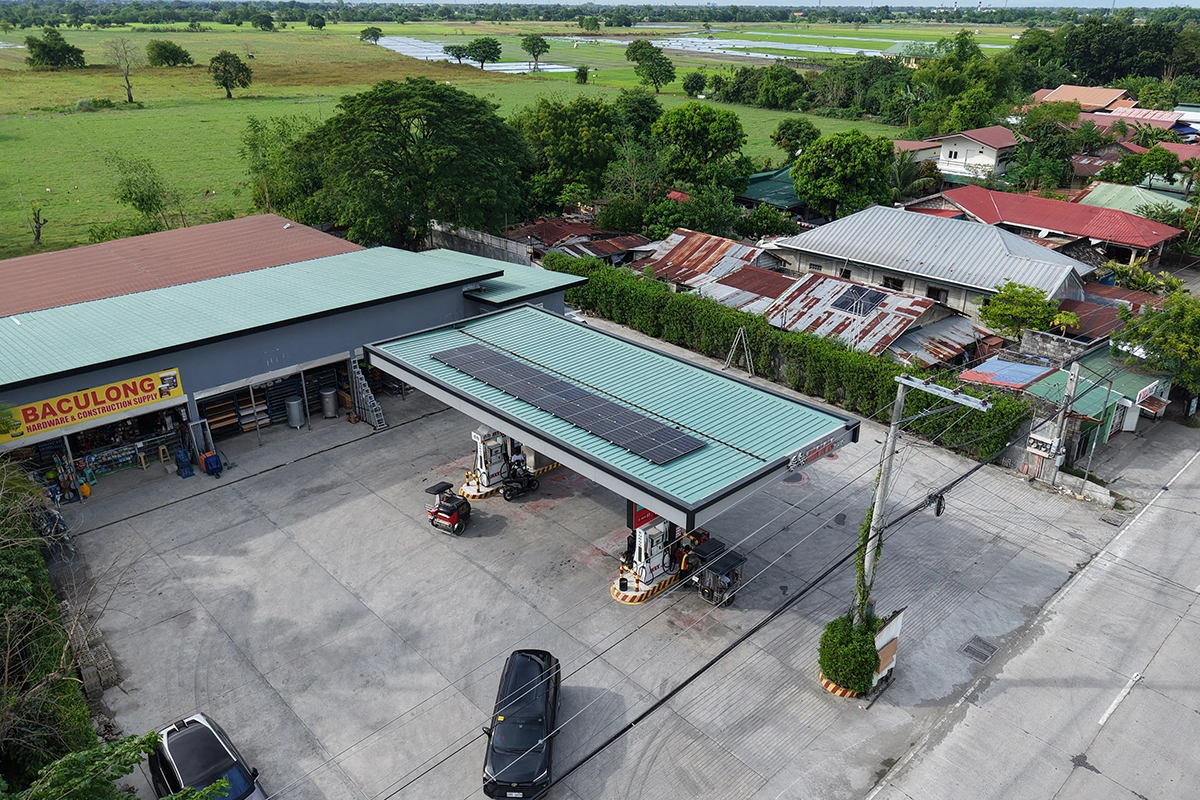
For commercial sites with both fuel sales and adjacent business space, predictable daytime consumption makes storage particularly effective. At KKK Gasoline in Baculong, the system was designed around consistent pump usage, lighting, and tenant load, allowing a battery bank to cut grid draw during peak hours and support critical services during voltage dips. The combination of reliable daytime patterns and operational continuity needs made behind-the-meter storage a clear choice for managing costs while maintaining uptime.
Five proven technologies
- Lithium iron phosphate (LFP) battery banks: 6,000+ cycles, 96 percent round-trip efficiency, ideal for daily cycling.
- Lithium NMC modular packs: High energy density, compact footprints for rooftops with limited floor area.
- Vanadium flow systems: Electrolyte lasts more than 20 years, no thermal runaway risk, suited to large industrial solar power systems.
- Sodium-ion packs: Fast-charging chemistry entering the market with lower material cost; watch for rapid price drops through 2026 and 2027.
- Hybrid inverter plus battery combo: Single skid that combines MPPT, inverter, and storage, quick to mount during customized energy solutions roll-outs.
How to size a bank
Start with 24-hour load curves. Match at least one half of nighttime kWh to cover basic operations and security loads. A retail chain drawing 400 kWh after sunset may install a 200 kWh LFP rack. Pair capacity with inverter output: a 200 kWh bank links well with a 100 kW hybrid unit. Storage that deep-cycles daily needs 5,000+ cycle life for a ten-year service window. Adding 20 percent headroom keeps discharge depth below 85 percent and extends life.
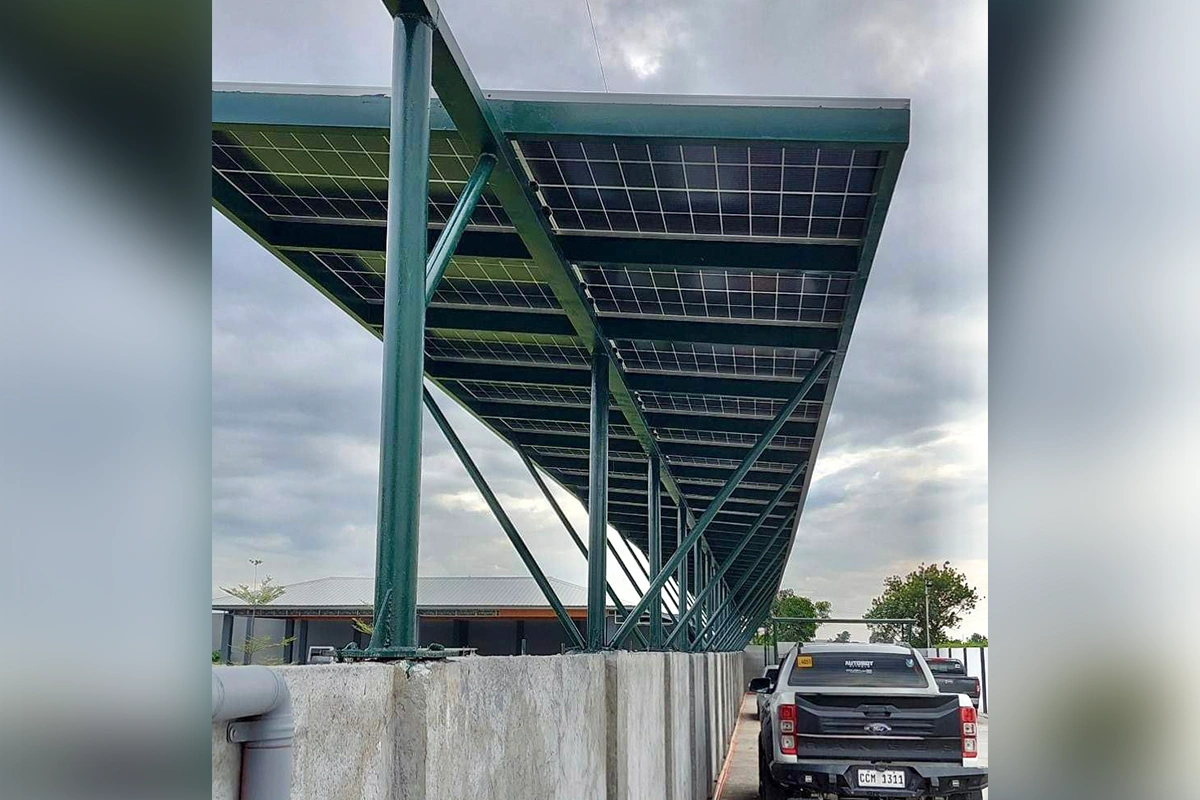
At ProBuild Tarlac, battery storage was added to an existing commercial solar array to meet significant nighttime loads in the administrative offices and yard operations. By analyzing 24-hour load curves, the system was sized to carry essential operations after sunset while reducing peak imports during workday spikes. This is a practical illustration of how storage can be tailored to facilities with meaningful off-grid use beyond typical business hours.
Making sure it fits your solar setup
Your inverter must match your battery in both technology and voltage. Modern hybrid inverters manage solar panels and batteries simultaneously, deciding automatically when to charge, discharge, or export to the grid. Ask your installer to show how the system prioritizes loads, schedules charging, and displays performance data. Good design lets you see real-time power flow and gives you control over where your energy goes.
At Solaren, engineers verify that each battery model communicates correctly with the inverter and that the software supports all manufacturer requirements for warranty and safety. A system that looks right on paper but has compatibility gaps between inverter firmware and battery BMS will underperform from day one.
When storage makes the most sense
Energy storage delivers the most value when power reliability directly affects revenue or operations. Manufacturing plants, cold storage facilities, data centers, and offices running critical equipment all benefit from uninterrupted energy. For commercial clients, the calculus is usually simple: calculate the hourly cost of downtime, compare it against the annualized cost of a battery bank, and the decision makes itself.

At the Five Star Bus Terminal, power demand is continuous, serving round-the-clock passenger operations and critical systems. The site uses an oversized solar array paired with battery storage to supply nighttime loads, while maintaining generator integration for extended grid outages. The system prioritizes critical circuits and is designed to withstand multiple failures, ensuring uninterrupted operation under all conditions.
For hotels and hospitality facilities, the driver is different but equally compelling. At El Cabalen Hotel, a battery-integrated solar system captures excess daytime generation and stores it to support evening and overnight loads. This approach reduces dependence on grid power during peak tariff periods while maintaining guest comfort, making storage a practical tool for daily cost control rather than emergency backup alone.
Even for smaller commercial premises, a modest battery bank paired with rooftop solar can keep lighting, security systems, point-of-sale terminals, and refrigeration running through extended outages, which in many parts of the Philippines still happen several times a month.
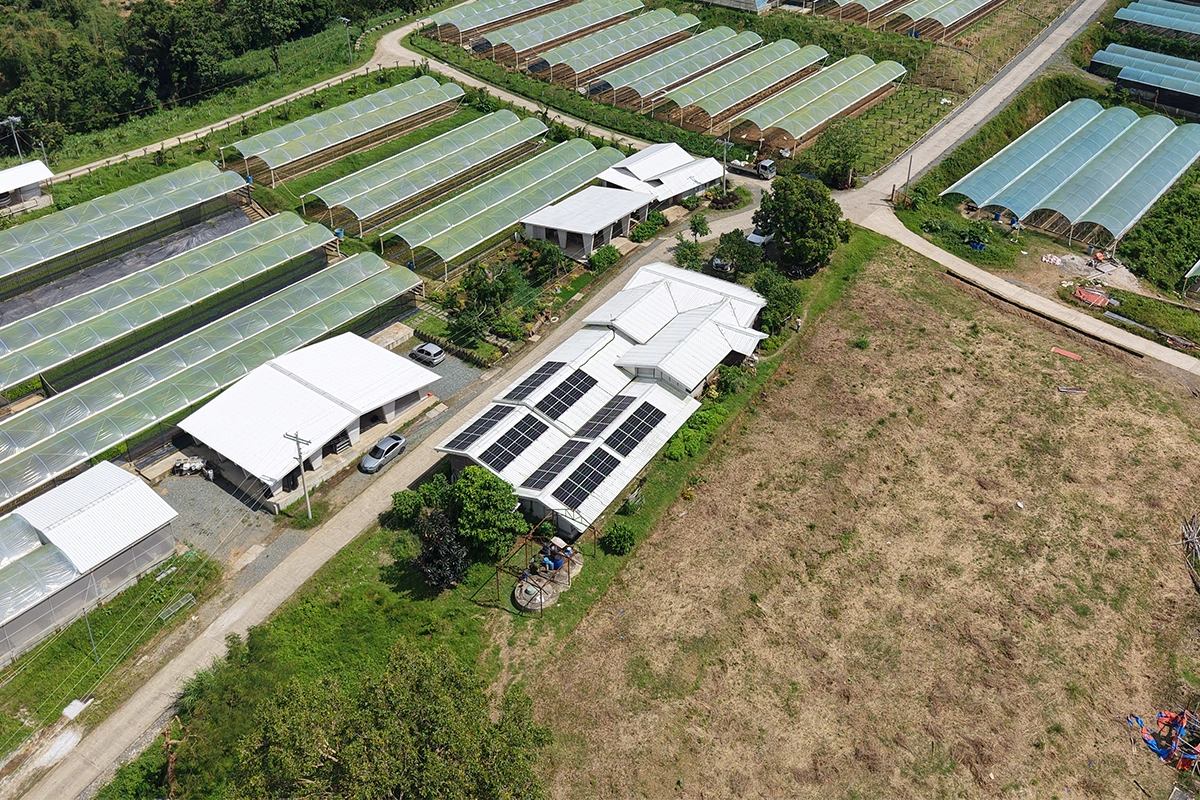
The Kayrilaw installation is a good illustration of a site where the case for hybrid was clear from day one. Served by a remote BATELEC supply with chronic voltage instability and frequent outages, storage was not an optional upgrade but a design requirement. You can read the full project details here.
Regulatory update 2026
The Energy Regulatory Commission now classifies behind-the-meter batteries as part of renewable energy storage solutions. Net metering export caps remain at 100 kW AC, but stored solar exported at night still earns a ₱5.638 per kWh credit. Businesses over 100 kW join the Renewable Portfolio Standard and may trade green certificates. Solaren handles all filings so owners focus on operations, not paperwork.
Combining storage with net metering

Adding batteries does not mean giving up net metering. The two work together. During the day, solar panels power your facility, charge your batteries, and feed any surplus to the grid. At night, your batteries supply your loads, and your grid credits reduce the next bill. You are generating, storing, and exporting from the same system, each function reinforcing the others.
This matters most for businesses with high daytime generation relative to consumption. Instead of exporting all surplus at ₱5.638 per kWh, you store what you can use profitably at night and only export the genuine excess. Over a year, the combined effect of avoided peak purchases and net metering credits compresses payback more than either mechanism does alone.
Real-world savings: Solaren case study
A snack-food plant in Laguna added 400 kWh of LFP storage to its 1 MWp rooftop array. The bank flattens the late-day spike when fryers and packaging lines ramp up. Grid draw fell by 38 percent within the first month. With current rates at ₱12.00 per kWh during peak, the plant saves about ₱1.4 million each quarter. Payback stands at 4.2 years. The system feeds surplus back at ₱5.638 per kWh through net metering.
Maintenance and safety
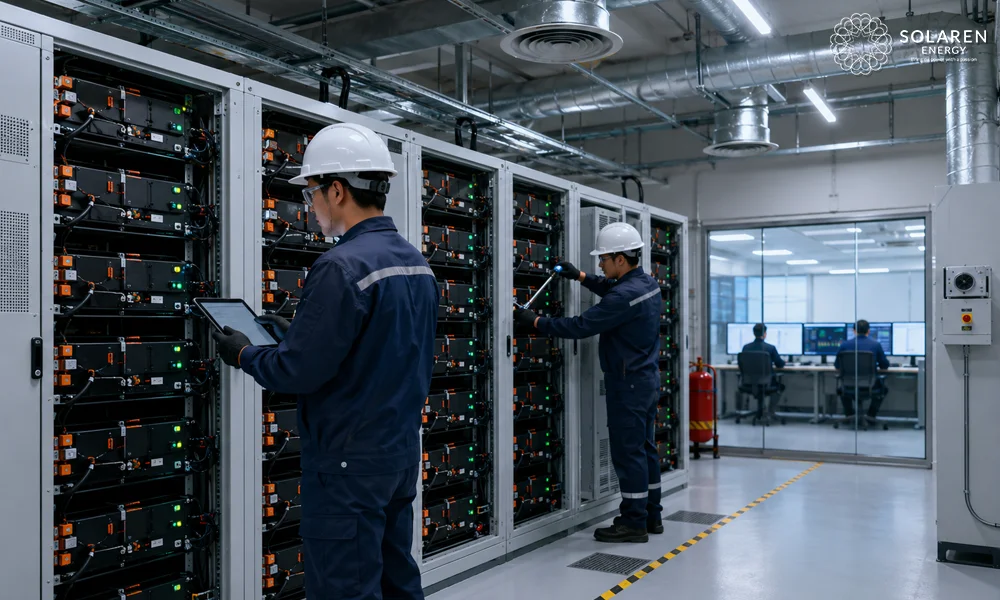
Modern battery racks include fire-retardant housings, automatic gas extraction fans, and cell-level monitoring. Weekly visual checks and quarterly torque audits keep warranties intact. Software pushes alerts to Solaren’s monitoring desk and on-site teams. Annual operational expense runs below ₱90 per kWh of installed capacity, far less than the cost of unplanned downtime.
Lithium-ion batteries typically last ten to fifteen years with almost no maintenance. Heat and poor ventilation shorten battery life, so the installation environment matters. Check the warranty closely. Reliable brands provide both product and performance coverage measured in years or charge cycles.
Financing and ROI timeline
Many firms fold storage into the same loan as the main solar contract. Three-year terms at 7 percent APR often match cash flow from savings. A 200 kWh LFP rack with a hybrid inverter costs around ₱7 million. Monthly savings of ₱180,000 clear the note in 40 months. After the payoff, the bank delivers pure savings for at least six more years. Grants under the Green Energy Option Program can shave upfront costs by up to 10 percent for projects commissioned before December 2026.
Future cost trends and policy outlook
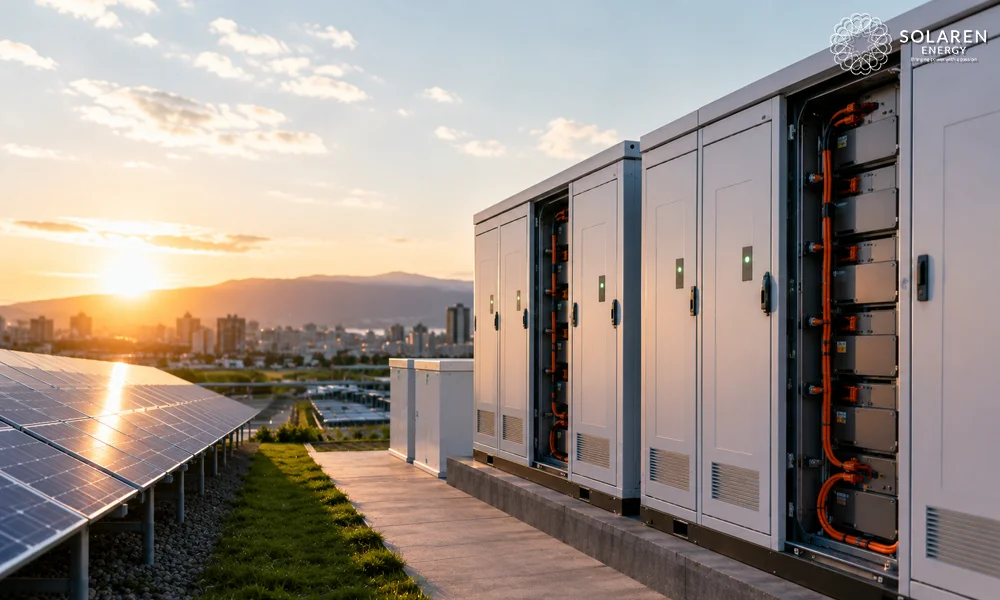
Battery prices have dropped 11 percent year-on-year since 2019. BloombergNEF forecasts another 30 percent slide by 2028 as sodium-ion production scales in Asia. The Philippine Board of Investments now lists large-scale batteries as priority equipment, unlocking VAT exemptions on import duties. Forward-thinking firms that install today lock in savings while hedging against future carbon levies on grid-supplied power.
Talk to Solaren today and lock in stable power at a predictable cost.
Frequently Asked Questions

-
Do I need battery storage if I am in a Meralco or stable cooperative franchise area?
Probably not, at least not yet. Stable grid areas already provide a form of energy buffering through net metering, where surplus solar generation is exported to the grid during the day and drawn back at night or during low-generation periods. This arrangement effectively uses the grid as a zero-capital-cost battery. For most businesses in stable franchise areas, a grid-tied solar system with net metering outperforms a hybrid system financially. Battery storage becomes worth evaluating when your grid reliability changes, when your load profile shifts, or when battery costs fall far enough to change the payback calculation.
-
How much battery capacity does a typical commercial business actually need for meaningful backup?
Far more than most initial proposals suggest. A 10 kWh battery provides roughly two to four hours of partial load coverage for a typical commercial space, assuming loads are managed carefully and air conditioning is reduced. For meaningful backup across a full commercial operation including HVAC, a business realistically needs 30 kWh to 50 kWh or more of usable storage capacity. The gap between what sounds sufficient in a sales conversation and what the numbers actually require is significant. Always ask the provider to model your specific load profile before agreeing to a battery size.
-
What types of businesses have the strongest case for battery storage in the Philippines?
Businesses in weak-grid or remote locations with frequent outages and long restoration times. Cold chain operations, food processing plants, medical facilities, and any business where a power interruption causes immediate product loss or safety risk. Facilities with significant diesel generator running costs that can be replaced with battery storage at comparable or better total cost. Agricultural operations in remote locations dependent on irrigation and water systems. If your business does not fall into one of these categories, the financial case for storage is likely weaker than a standard grid-tied solar installation with net metering.
-
What is the difference in payback period between a grid-tied solar system and a hybrid system?
It varies by site, but the difference is material. A grid-tied system for a commercial business in a stable grid area typically achieves payback in three to six years. Adding battery storage increases capital cost significantly and extends payback in most cases, because the batteries are solving a problem the grid is already solving through net metering. The exception is when storage replaces expensive diesel generator use, in which case the saved fuel cost can justify the battery capital and keep payback competitive. Always ask for both scenarios modeled against your actual electricity bills before deciding.
-
Will battery prices continue to fall and is it worth waiting?
Battery costs have been declining consistently for years and that trend is expected to continue. For businesses in stable grid areas where storage is not urgently needed for operational continuity, there is a reasonable argument for installing a hybrid-capable solar system now and deferring the battery purchase by two to three years. By then, both technology and pricing will likely have improved further. A well-specified inverter installed today can accommodate battery addition later without replacing core components, provided this option is built into the original system design.
-
How do I evaluate whether a storage proposal is genuinely suited to my situation?
Ask the provider to show you the payback period with and without batteries, side by side. Ask them to specify exactly what loads the battery system will cover and for how long at your actual consumption levels. Ask whether the system is designed to add batteries later if you choose to defer. Ask for references from comparable commercial installations in a similar grid area. A provider confident in their product will answer all of these questions directly. Vague answers or reluctance to model the no-battery scenario are warning signs worth taking seriously.
-
What happens to batteries at the end of their cycle life?
Commercial lithium iron phosphate batteries, the chemistry most commonly used in Philippine commercial installations, typically carry a cycle life warranty of 3,000 to 6,000 cycles, depending on the manufacturer, which translates to roughly 8 to 15 years of daily cycling. After that, battery capacity degrades to the point where replacement becomes necessary. This replacement cost is a real financial consideration that should appear in any honest payback model. Ask your provider what the replacement cost assumption is in their financial projections and whether it is included in the payback calculation they are presenting.