Most conversations about solar power systems in the Philippines start with the financial case. Payback periods, bill reductions, return on investment. Those numbers are real and they matter. But the financial return on any solar installation depends entirely on whether the system was built correctly, connected legally, and approved by the right authorities. A solar power system that bypasses compliance is not a discounted investment. It is a liability.
This is not a theoretical concern. We are currently fixing an installation on a commercial site where the original contractor completed the physical installation without obtaining the required permits or processing the net metering application. The system was generating. But it was generating into a distribution connection that was not legally approved, the metering was not configured correctly, and the client had no legal standing to claim net metering credits. Two years of potential credits were lost before the problem was identified.
That situation is avoidable. But avoiding it requires understanding what compliance actually means for a solar power system in the Philippines, and why it matters more than most buyers realise when they are comparing proposals.
What Philippine Solar Compliance Actually Requires

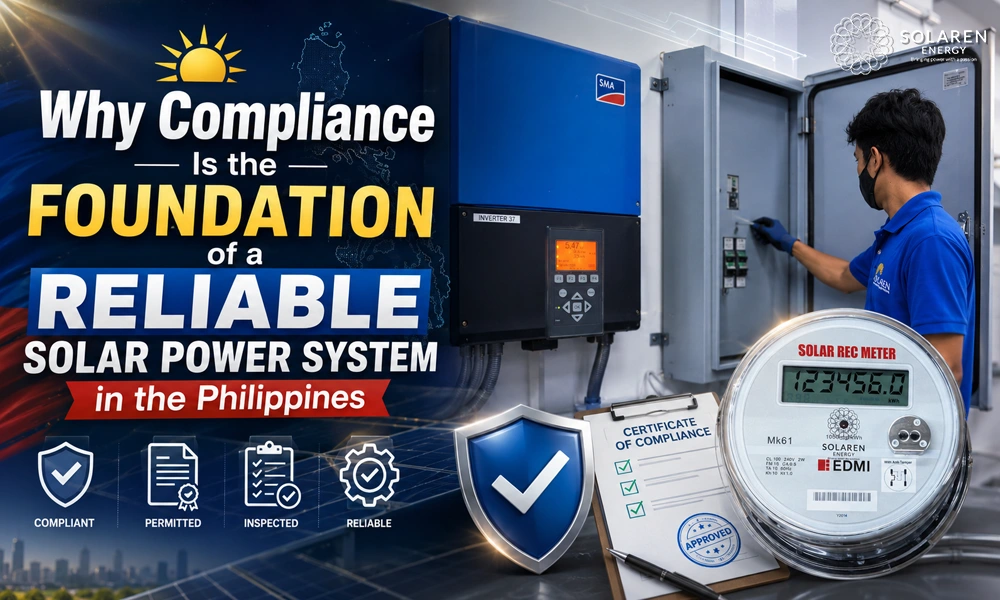
A compliant solar power system installation in the Philippines involves multiple regulatory layers that operate simultaneously.
The Department of Energy maintains an accreditation register for renewable energy contractors. Working with a DOE-accredited company ensures the installer meets national technical and safety standards for renewable energy work. The Philippine Contractors Accreditation Board licenses construction contractors, and solar installation is construction work. PCAB licensing is a legal requirement, not a recommendation. A contractor without current PCAB accreditation is not legally permitted to execute a commercial solar installation in the Philippines, regardless of how capable their engineers are.
Local government units add a further layer. Building permits, electrical permits, and Certificates of Final Electrical Inspection are required before a system can be legally commissioned. In some LGUs, including Makati and parts of Cavite, contractor credentials must be submitted before a work permit is issued at all. An unaccredited contractor cannot start work in those jurisdictions.
Finally, the distribution utility must approve the grid connection and process the net metering application before the system can export surplus generation for credit. This requires documentation that demonstrates the system meets the utility’s interconnection standards. An unaccredited installer producing non-compliant documentation will see that the application is rejected or delayed indefinitely.
Each of these requirements exists independently. Satisfying one does not satisfy the others. A system can be DOE-compliant and LGU-permitted but still fail utility interconnection if the technical documentation is not correctly prepared. Getting all of them right simultaneously is the job of an experienced EPC with a track record across multiple utilities and multiple LGUs.
The Compliance-Financial Return Connection

This is where the practical and financial arguments converge.
Every day between commissioning and approved net metering is a day of lost export credits. For a 100kWp commercial installation generating a meaningful surplus, that is a calculable daily loss. Across the weeks or months that a poorly managed compliance process can take, the accumulated loss is significant.
Power factor correction, surge protection, and export limiting hardware all have compliance dimensions that affect both safety and financial performance. A defective or incorrectly specified export limiting device can cause the meter to run additively rather than subtractively. Instead of earning credits for exported energy, the client is billed for it. This has happened on multiple Philippine sites. It is always discovered at the billing stage, not at commissioning, because nobody tested it properly.
Solaren processes compliance documentation for every installation it completes. Not one system in over a decade of operations has been left without proper permits and grid connection approvals. That record exists because compliance is treated as an engineering discipline rather than an administrative afterthought.
The Net Metering Framework in 2026

The regulatory environment for net metering has improved meaningfully. Under Executive Order 110 and ERC guidelines, distribution utilities are now required to process complete net metering applications within ten working days. The intent is clear — to remove the bureaucratic friction that previously made net metering approval slow and unpredictable for ordinary commercial and residential users.
The ten-day mandate is the legal standard. The practical reality is that many distribution utilities, particularly smaller rural cooperatives, are processing application volumes significantly higher than their administrative systems were designed for. They are not obstructing the process deliberately. They are managing a backlog that the rapid growth of solar adoption has created faster than their processes have adapted.
What this means practically is that documentation quality matters enormously. A complete, correctly formatted application submitted to the right department starts the clock. An incomplete application does not. An application submitted to the wrong contact within the utility does not. The difference between approval within the regulatory window and approval months later is almost always documentation quality and follow-up discipline, not utility obstruction.
Solaren manages the entire net metering application process on behalf of every client across every distribution utility it works with. The requirements differ between utilities. The submission formats differ. The follow-up contacts differ. That knowledge is accumulated through repeated engagement with specific utilities over the years and is not available in any public document.
What to Verify Before You Commission

Before switching on any solar power system, four things should be confirmed.
The building permit and electrical permit should be in hand. The Certificate of Final Electrical Inspection should be scheduled. The net metering application should have been submitted with an acknowledgement of receipt from the utility. And the metering configuration should be tested to confirm the export credit function is working correctly in both directions before the system goes live.
An installer who hands over a commissioned system without all four of these confirmed is handing over an incomplete project, regardless of how well the panels are installed or how much the system generates.
For businesses evaluating solar proposals, choosing a solar EPC in the Philippines covers the full evaluation framework, including the compliance questions that distinguish a complete installation from an incomplete one.
Frequently Asked Questions
-
What happens if my solar power system is installed without proper permits in the Philippines?
The consequences are practical and financial rather than immediately visible. A system installed without an Electrical Permit and Certificate of Final Electrical Inspection cannot be legally commissioned. A system connected to the grid without utility approval is operating outside the net metering framework and earning no export credits. If the distribution utility or a government inspector identifies the non-compliant connection, the system may be required to disconnect until compliance is achieved. The cost of retroactive compliance, including documentation, inspections, and utility resubmission, typically exceeds what proper compliance would have cost at the outset. And any credits that would have accumulated during the non-compliant period are permanently lost.
-
Does the type of distribution utility affect how difficult net metering approval is?
Yes, significantly. Larger utilities with dedicated renewable energy processing departments tend to handle applications more efficiently than smaller rural cooperatives managing higher application volumes relative to their administrative capacity. The ten-day processing mandate under ERC rules applies to all utilities equally, but the practical experience of getting through that process varies considerably. An EPC with documented experience across multiple utilities in your area will know what each one specifically requires and how to format the submission correctly from the first attempt, which is the most reliable way to stay within the regulatory window.
-
Can I lose my net metering approval if I modify my solar power system later?
Material changes to a net metering-approved system, including adding capacity, replacing the inverter, or changing the export configuration, typically require notification to the distribution utility and may require a new or amended interconnection agreement. The specific requirements depend on the nature of the change and your utility’s policies. Minor changes, such as replacing a failed panel with an identical model, generally do not affect the approval. Significant changes that alter the system’s output profile or interconnection characteristics are more likely to require formal reprocessing. Always confirm with your EPC before making any change to an approved system.