Most attention to a solar power installation in the Philippines ends the day the system switches on. The panels are up. The inverter hums. Everyone shakes hands, photos are taken, and the project folder closes. What happens in the weeks, months, and years after that day gets far less attention, and that is exactly where many Philippine businesses are left guessing.
After commissioning, a solar power installation in the Philippines enters a phase covering four things: performance verification against the design model, the net metering application with your utility, a light but non-negotiable maintenance routine, and a long-term service relationship with your EPC. Getting these four right determines whether the system delivers what the financial model promised.
This guide covers that phase in full. It is written for business owners and facilities managers who have recently commissioned a commercial system or who are evaluating a solar power installation and want to know how the ongoing relationship with their system and their contractor should actually work.
The first 30 days: baseline and verification
The period immediately after commissioning is the most important for confirming the system performs as designed. A well-engineered installation delivers generation data within a predictable range from the very first week. If your contractor provided a PVsyst or equivalent energy simulation as part of the project documentation, month-one figures should sit reasonably close to the modeled projections for the same period.
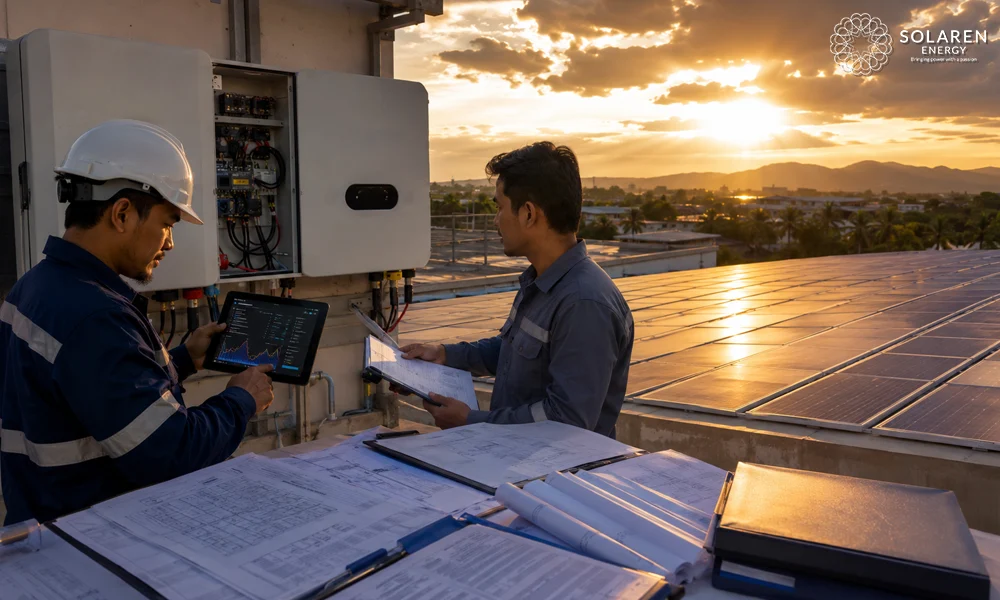
Within 30 days of commissioning, and in some cases from day one, your installer should hand over:
- Monitoring platform access with confirmed login credentials and a walkthrough of the dashboard. Record those credentials somewhere safe.
- Signed as-built drawings showing the final installed configuration, string layouts, and a single-line diagram.
- Copies of all permits, with utility interconnection approvals at least underway.
- The net metering application reference number and the expected processing timeline from your distribution utility.
- Inverter and panel warranty certificates registered in your company name.
Solaren provides all of the above as part of its standard turnover package. If your EPC has not delivered these within 30 days, request them formally in writing. The paper matters later.
Understanding your monitoring system
Every grid-tied commercial system includes a monitoring platform, typically from the inverter manufacturer. Huawei systems use FusionSolar. SMA systems use ennexOS. These platforms give real-time visibility into generation, string performance, and fault alerts.
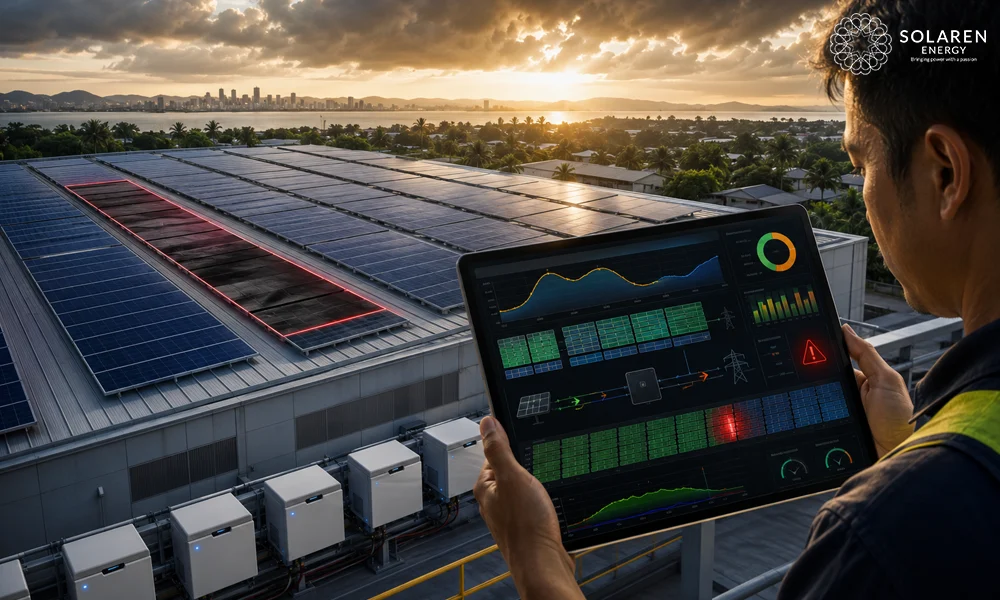
Most owners check one number: total generation. The useful data sits deeper.
String-level performance: A healthy system shows consistent output across all strings during peak sun. A string producing noticeably less than its neighbors in clear weather usually points to a wiring issue, a faulty panel, or shading the original design did not fully account for. Flag it to your contractor early.
Specific yield: Expressed as kilowatt-hours per kilowatt-peak (kWh/kWp), this normalizes output against installed capacity. A well-sited commercial system in most of Luzon and the Visayas should achieve 1,200 to 1,400 kWh/kWp annually, somewhat lower in areas with persistent cloud cover. A first full year consistently below that range deserves investigation.
Performance ratio: This compares actual generation against what the system would theoretically produce at full efficiency under real irradiance. A properly installed system in Philippine conditions typically lands between 75 and 82 percent. Materially lower figures suggest losses from soiling, shading, inverter clipping, or degraded equipment.
Net metering: what actually happens after application
Net metering lets your system export surplus energy to the grid and earn a credit against your bill. The application goes in after commissioning and is processed by your distribution utility. For most of Metro Manila, that means MERALCO. Outside it, usually a rural electric cooperative.
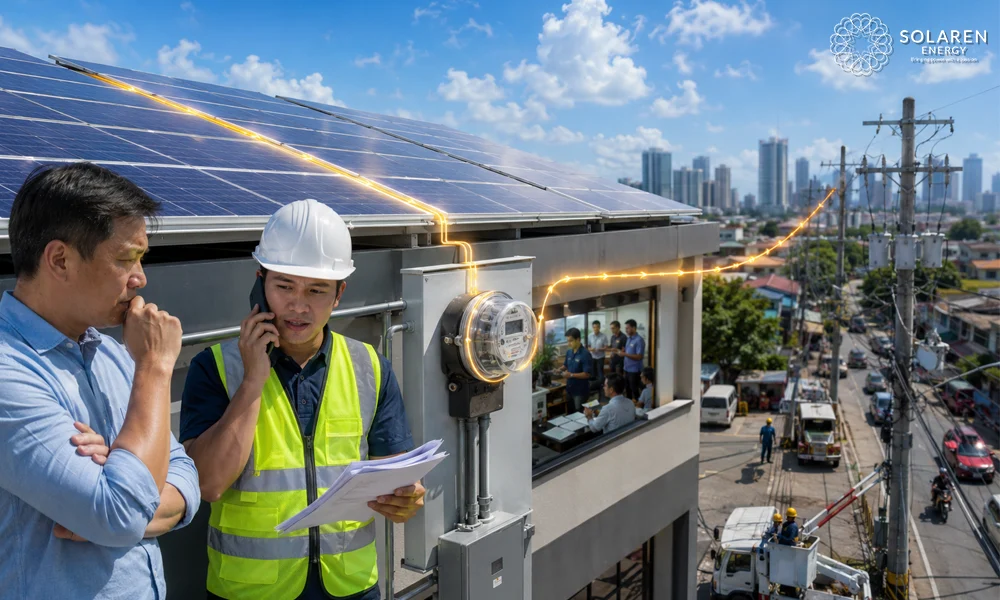
Despite rules mandating fast processing, real timelines vary. MERALCO applications for systems below 100 kW AC typically take 30 to 90 days from a complete submission, and the clock stretches further if the LGU delays electrical permits for any of a dozen reasons. Cooperatives can take longer still, depending heavily on workload and administrative capacity. Your contractor should handle the submission and follow up aggressively on your behalf.
Here is the cost nobody mentions at the sales stage. Between commissioning and net metering approval, exported energy earns little or nothing. Whatever your system generates above your in-house daytime consumption during that window is effectively donated to the grid. On large systems with real export volumes, the gap represents meaningful lost earnings, which is precisely why the follow-up matters.
Solaren manages net metering submissions for every client and tracks application status with each utility. Where delays look likely, Solaren coordinates directly with the utility to push the review along.
Ongoing maintenance: what is required and how often
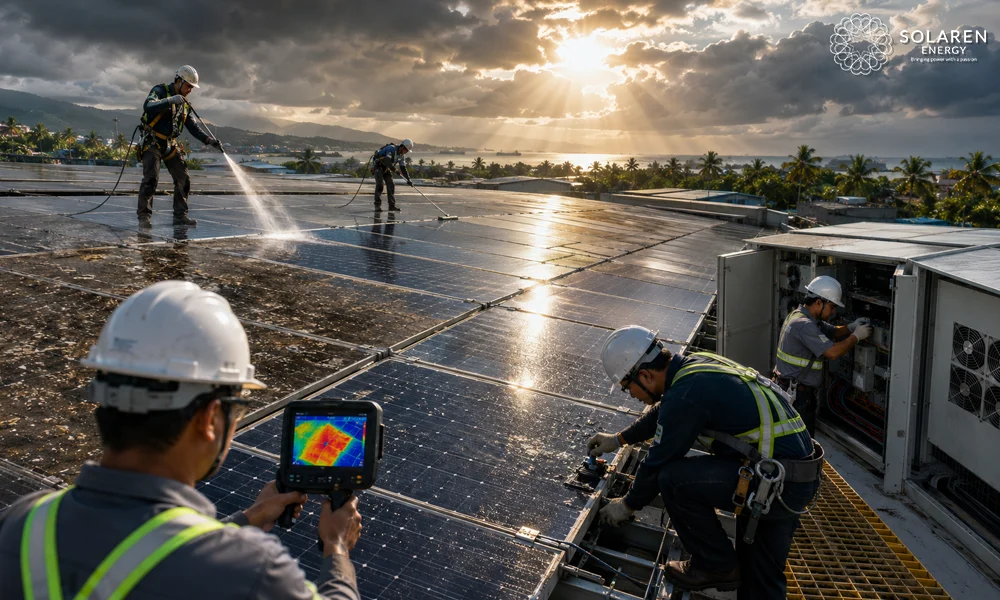
A commercial solar power installation in the Philippines is not a set-and-forget asset. It needs periodic attention to hold the output levels the financial model assumed. The honest news: the maintenance burden is genuinely light compared with almost any other mechanical system on your site. The risk is that it is light enough to be neglected entirely, and neglect produces measurable, sometimes dramatic, generation losses over time.
-
Cleaning
Dust, bird droppings, and debris on panel surfaces cut light absorption and output. In areas with heavy dust or industrial fallout, cleaning every one to three months is reasonable. Coastal sites may need more frequent attention because of salt film. Water and soft brushes handle most commercial arrays.
Your monitoring data is the best guide to cleaning frequency. If specific yield declines between periods of otherwise consistent weather, soiling is the first thing to check.
-
Annual inspections
A yearly inspection by an accredited company with a licensed engineer should cover:
- Torque checks on all mounting hardware and panel clamps
- Visual inspection of DC cables, conduits, and junction boxes for rodent damage or UV degradation
- Inverter filter cleaning and ventilation check, which is critical for cooling and efficiency
- Earthing continuity test
- Thermal imaging scan of the array to find hotspots indicating panel defects or connection faults
- Review of inverter event logs for fault patterns
Thermal imaging deserves a special mention. A single defective cell in a series string creates a hotspot that drags down the whole string and, left alone, risks physical damage to the panel. Thermal scans catch these problems before they become warranty claims or safety hazards.
-
Inverter servicing
String inverters typically carry five to ten-year warranties, with many manufacturers offering extensions on registration. Inverter replacement is the single most likely capital expense during the operational life of the system. Budget for it at the outset, usually in the ten to fifteen year range for string inverters, depending on operating conditions.
What good after-sales support really means
The most important question before any solar project proceeds is not about equipment or price. It is about who answers the phone when something goes wrong two years from now.
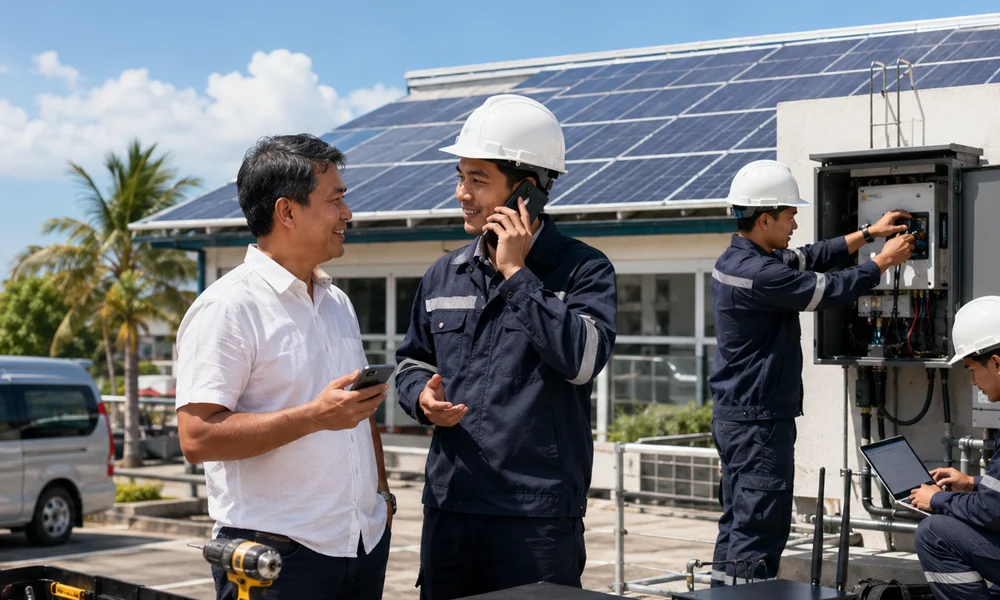
The Philippine solar industry has a well-documented contractor longevity problem. A significant share of installers active today will not exist in their current form within five years. Against a 25-year asset, that is a real risk. The inverter fault in year six, the mounting bracket that needs replacing after a typhoon, the monitoring platform that stops syncing after a firmware update: every one of these needs a contractor who is still around and still capable.
Credible after-sales support looks like this:
- A named technical contact with a direct number, not a general inquiry inbox
- A committed fault-response time written into the service agreement
- Remote monitoring access the contractor can use to diagnose faults without a site visit, which sometimes requires specialist routers and should be hardwired at the outset
- A clear warranty claims process the contractor runs on your behalf with the manufacturer. Confirm your contractor has direct manufacturer access rather than buying through local traders.
- Annual O&M visits included or available under a maintenance contract
Solaren does not subcontract. Every system carrying the Solaren name was built by Solaren engineers, which means the people who understand your system are still available to service it. That is not standard across the Philippine market. Before signing with anyone, it is worth reviewing the top 10 questions to ask before signing a solar installation contract.
Reading your electricity bill after solar
The first bill after going solar often surprises business owners, and not always pleasantly. Reading it correctly takes a small adjustment.
Grid consumption falls. Before net metering approval, the bill shows gross consumption from the grid. After approval, a net metering credit line reduces the payable amount, calculated against the blended generation charge, normally the first line item on the bill.
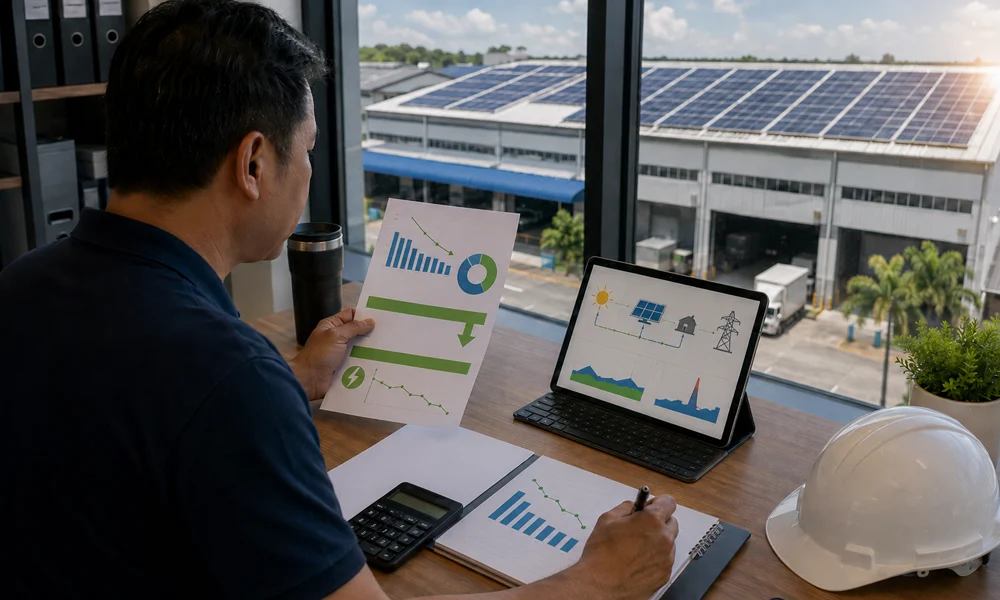
Demand charges are a different animal. For industrial accounts billed on demand, solar cuts energy consumption charges substantially, but its effect on demand charges is often negligible, because demand is measured at peak draw, and peak draw does not always coincide with solar production. A system large enough relative to the facility’s profile can trim the peak figure when it occurs in daylight hours, but solar alone does not eliminate demand charges. For sites where those charges dominate, pairing solar with energy storage solutions is the conversation worth having.
The most useful monthly comparison is not the bill amount. It is the bill relative to consumption. Track your blended peso per kWh cost. Over time that number should fall against your pre-solar baseline, adjusted for tariff increases. It is the most honest measure of what the system is contributing, and the foundation for any serious ROI analysis.
When to escalate a performance concern
Most performance issues are minor and resolve quickly. Some deserve escalation. Act on these thresholds:
- Specific yield more than 15 percent below modeled projections over a full calendar month, after accounting for genuine weather differences
- Any string showing zero output for more than a day without a clear fault code
- Inverter shutdowns more than once a week outside periods of grid instability
- A monitoring platform offline for more than 48 hours without explanation
- Physical evidence of water ingress at any junction box or conduit entry
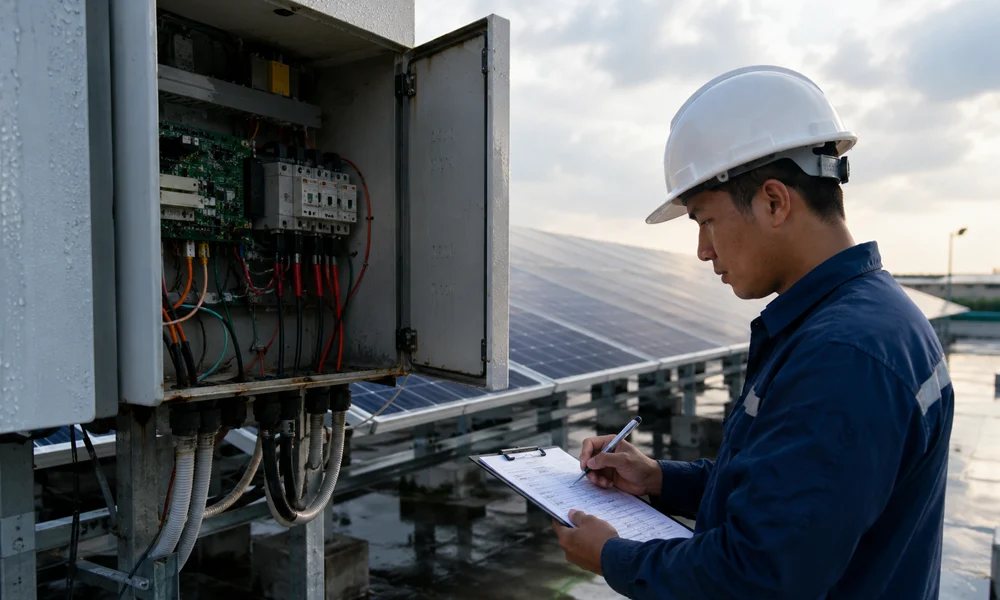
In every case, the right first step is contacting your EPC with a written record of what you observed and when it began. Remote diagnosis should be possible for most fault types. Where a site visit is needed, a credible EPC has a committed response time in your service agreement.
The long view: what a 25-year asset should show
Panel manufacturers publish performance warranties guaranteeing minimum output at year 25, typically 80 to 87 percent of original rated power for modern high-efficiency modules. Degradation is gradual and linear under normal conditions, around 0.4 to 0.5 percent per year for quality monocrystalline panels. Insist on a reputable Tier 1 manufacturer.
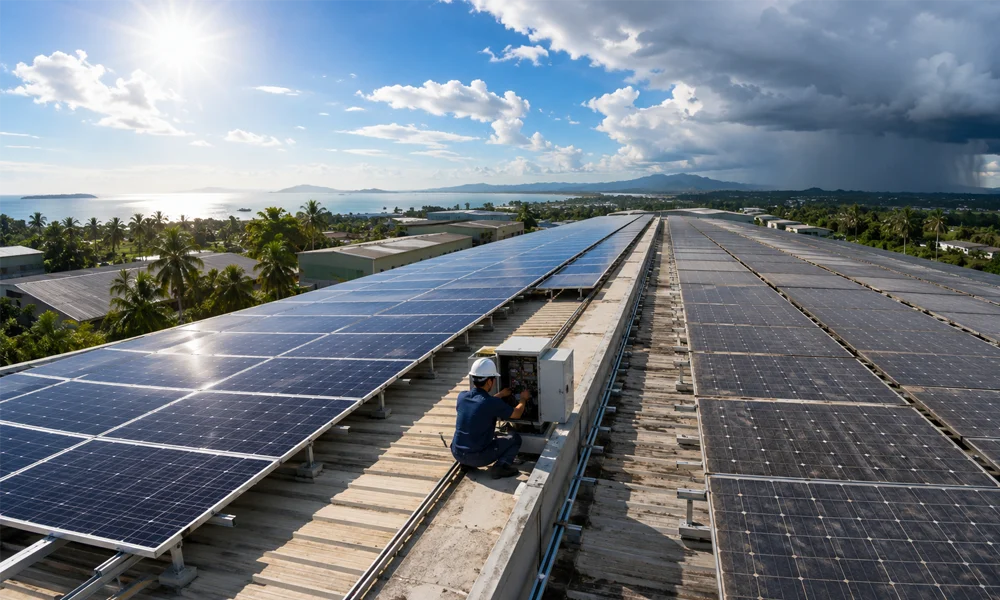
Put concretely: a 500 kWp system installed today should still deliver roughly 420 to 435 kWp-equivalent output in 2051. The financial model should reflect that curve rather than assume flat output for 25 years.
Inverter replacement remains the most likely capital event. Panel replacement before year 25 is rare under normal conditions, though typhoon damage or sustained thermal stress from poor ventilation can force it. A mounting structure properly specified for Philippine wind loads and protected against galvanic corrosion should outlast both panels and inverters without major intervention.
FAQs: Solar Power Installation in the Philippines
-
How long does net metering approval take in the Philippines?
For systems below 100 kW AC, MERALCO typically processes complete applications in 30 to 90 days. Rural electric cooperatives often take longer, and LGU permit delays can extend the timeline further. Your EPC should submit and follow up on your behalf.
-
How often should commercial solar panels be cleaned?
Every one to three months in dusty or industrial areas, more often on coastal sites with salt film. Let monitoring data guide you: a falling specific yield in stable weather usually means soiling.
-
What is a good performance ratio for a commercial system in the Philippines?
Between 75 and 82 percent under Philippine conditions. Consistently lower figures point to soiling, shading, inverter clipping, or equipment faults worth investigating with your contractor.
-
Who handles maintenance after commissioning?
The owner is responsible for the asset, but a credible EPC provides annual O&M visits, remote diagnostics, and warranty claims management under a service agreement. Confirm these commitments in writing before the project starts.
-
What is the highest cost after commissioning?
Inverter replacement, typically in years ten to fifteen for string inverters. Budget for it from day one so it never arrives as a surprise.
Conclusion
A solar power installation in the Philippines is a 25-year infrastructure decision, not a one-time equipment purchase. The commissioning ceremony is the start of the asset’s life, not the end of the project. Your monitoring discipline, the net metering follow-through, the maintenance routine, and above all the durability of your contractor relationship decide whether the system delivers what the model projected or quietly underperforms for years before anyone notices.
Solaren has completed more than 2,500 commercial and industrial installations across the Philippines, from single-site rooftops to multi-site portfolios, and handles commissioning, net metering, monitoring, and after-sales support under one roof. Browse the project portfolio to see the track record, or start with the fundamentals of solar installation in the Philippines and how to choose a solar panel installation partner. If you have questions about an existing system or are planning a new solar power installation, contact us for a technical consultation.