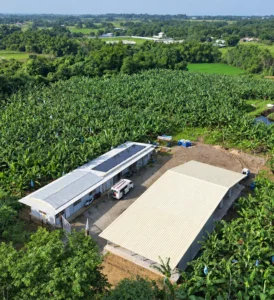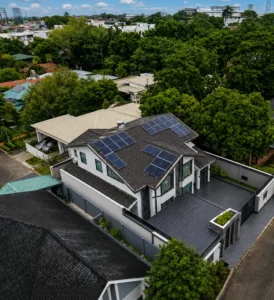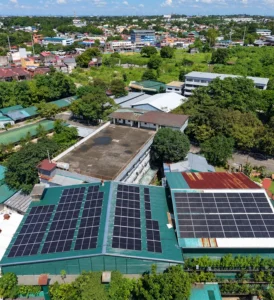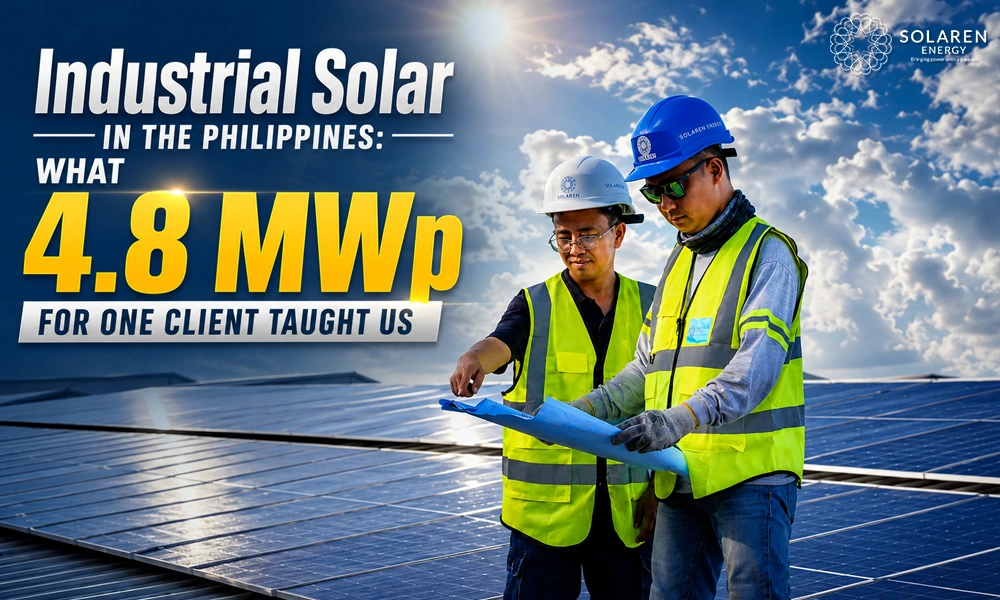
We could have written a typical brochure about industrial solar in the Philippines, saying it cuts energy costs, supports sustainability, and pays for itself. While all of that is true, it does not tell the whole story. Instead, we want to share a part of what we actually learned from working with one client: seven rooftop installations for Liwayway Marketing Corporation, the company behind Oishi, built in phases since October 2021 and now totaling 4,802.95 kWp. The latest phase started operating on July 15, 2026. Over five years and seven roofs, this client kept coming back. That experience taught us more about industrial solar than any theory could, and here are some of the lessons we learned.
Industrial solar in the Philippines is most effective when it is designed around the factory’s production needs, not only the roof. Since October 2021, Solaren has installed 4,802.95 kWp for Liwayway Marketing Corporation (Oishi) over seven phases. The newest phase in Imus, Cavite, adds 1,532.05 kWp, generating 2,259,774 kWh per year with an approximate 3.1-year payback. This is all without interrupting manufacturing.
One Client, Seven Rooftops
Repeat business is unquestionably the most genuine testimonial. A manufacturer does not order a second solar phase just because the first one looked good in photos or on a Facebook post. They do it because the first phase delivered the promised uptime and kilowatt-hours, as evidenced by the meter. Then comes a third phase. By the seventh phase, the partnership has endured changes in equipment, price cycles, a pandemic, wars, and even a global shipping crisis.
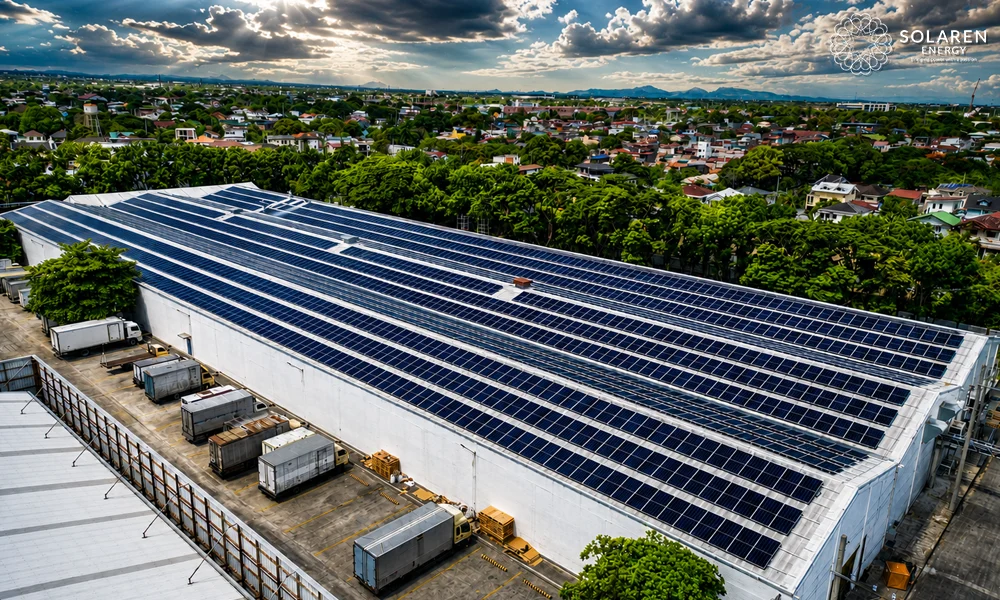
The program commenced in October 2021 and then expanded across Liwayway’s manufacturing sites, phase by phase. Each stage helped us better understand how a snack food plant uses electricity: compressors and manufacturing systems run nonstop, production lines adjust to demand, and daytime energy use closely matches solar generation. Phase 4, launched on July 15, 2026, at the Imus facility in Cavite, is the biggest phase so far at 1,532.05 kWp.
The Numbers From the Newest Phase
Phase 4 runs on LONGi 650 W back-contact modules feeding Huawei SUN2000-150K series inverters, with the whole plant visible in real time via FusionSolar monitoring. The engineering numbers: 2,259,774 kWh of expected annual generation, a specific yield of roughly 1,302 kWh per kWp, around 2,071 tonnes of CO2 avoided per year, and a payback of approximately 3.1 years.
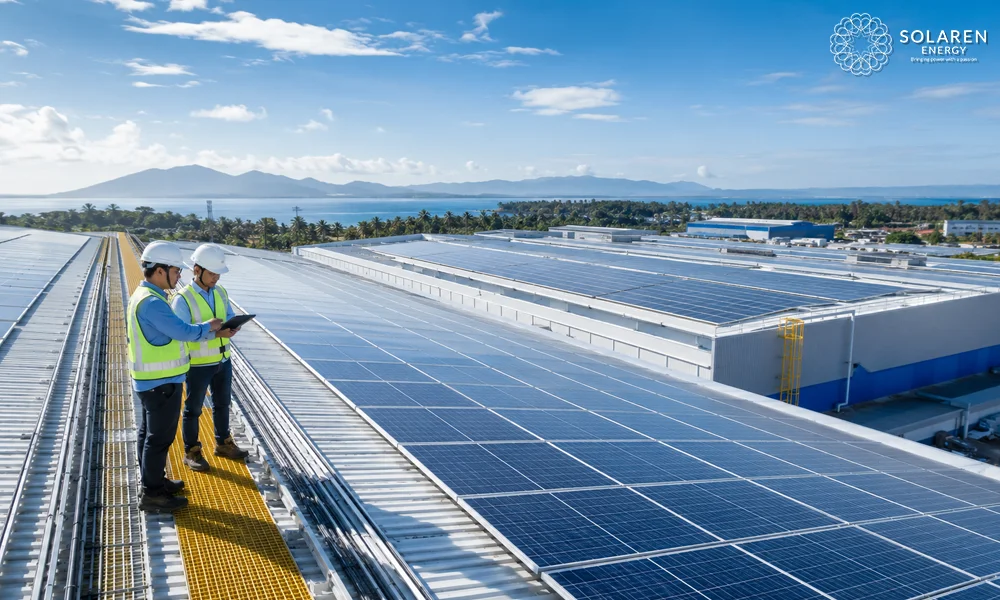
That yield number is worth a closer look. Our data from 103 monitored systems across the country averaged 1,298 kWh per kWp in 2025. For a rooftop as large as three football fields to match the average of much smaller systems shows that the design was carefully planned. We tested the various building loads, debated panel locations, string design, inverter loading, and cable runs. On a roof this big, a 1% difference in yield amounts to over 22,000 kWh per year. Careful planning and design pays off.
Lesson One: The Factory Comes First, the Solar Comes Second
A food manufacturing plant cannot pause operations. Not for a crane, not for pulling cables, and not for the installer’s convenience. Every phase of this project was built above and around active production lines. This imposes strict rules that office rooftops never require. Lifting is scheduled around production times. Anything that could fall, drip, or blow into a hygiene area is tightly controlled. Hot works permits are taken as seriously as electrical ones. The installation plan must be a coordinated manufacturing document first and a construction document second. If you get that order wrong, no payback calculation will fix the relationship.
Lesson Two: Industrial Loads Are a Gift, If You Size for Them
Factories are the best fit for solar in the Philippines. While homes often send extra solar power to the grid or store it, many factories can use it all. Their production runs through the middle of the day, so self-consumption rates are much higher than in homes or most commercial buildings. This is the main reason a system this size pays back in just 3.1 years.
But there is a catch. Size the solar system based on the actual load you can measure, not on what the client hopes to use in the future. We always record real consumption before designing anything, and with a phased program, we get the best data from how the previous phase performed. After seven phases, sizing is now more about tracking numbers than making guesses.
Lesson Three: Phasing Beats the Big Bang
Could we have built the entire 4.8 MWp system in one go? On paper, yes. In reality, doing it in phases is better for every reason an owner cares about. Each phase was, in effect, partially paid for with savings from earlier phases. Each one used the latest available technology, so the program includes everything from early mono modules to the back-contact panels in Phase 4A. Phasing also lets both sides test the partnership before making bigger commitments. Industrial solar is not just a purchase; it is a capital program, and these programs work best when executed patiently.
Lesson Four: Monitoring Is the Product
What Liwayway really bought, seven times, was reliable energy. The panels are just the tools. The real proof is in the monitoring, which is always running. Every phase connects to a platform that both we and the client watch. If the output drops, someone checks it before the monthly bill arrives. If a string goes down on Tuesday, it gets fixed by Wednesday. This discipline, more than any hardware, is what makes a five-year-old system a success story instead of a problem. It is also why we can share real production data, while others show only brochures and PowerPoint presentations.
Solar Power for Factories: What the Buyer Should Take From This
If you run a factory and are considering solar, here is a quick checklist based on the Liwayway project. First, ask for logged consumption data before anyone gives you a system size. Ask bidders exactly how they will build and integrate a system above your production lines without stopping them, and expect detailed answers with lifting plans and permit steps. Plan big projects in phases and use the savings to fund future growth. Make sure you get monitoring you can access yourself, not just monthly PDF reports. Finally, ask for references you can call, because in industrial solar, the best proof is a client who returns.
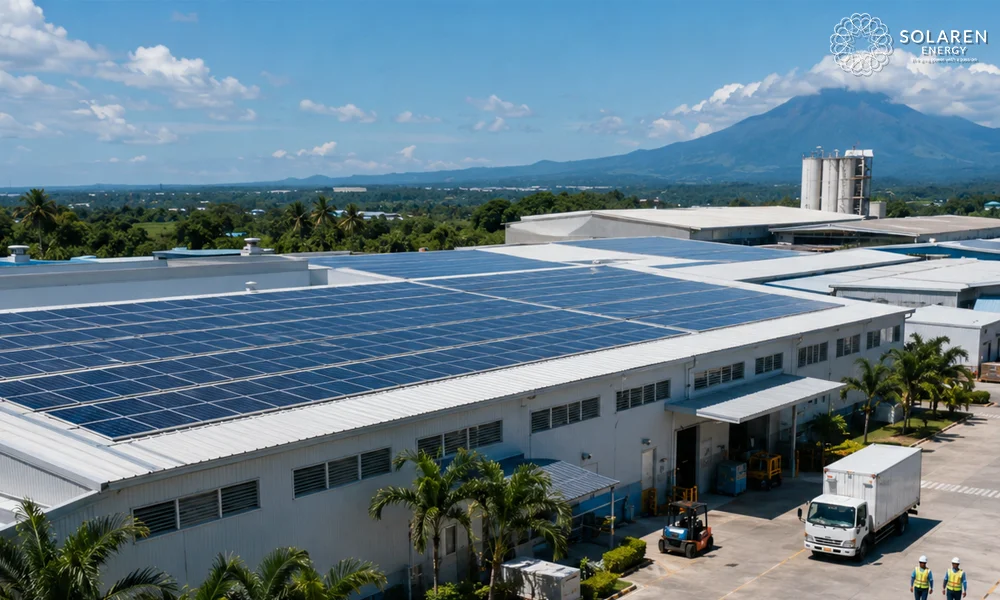
The economics usually work out on their own. Industrial power rates in the Philippines are among the highest in the region, and daytime factory loads closely match solar generation. Equipment prices are still good. A well-designed factory solar system here pays for itself in three to four years and then keeps producing for decades.
Frequently Asked Questions

- Is industrial solar in the Philippines worth it for manufacturing plants?
Yes, and factories are arguably the best candidates in the country. Daytime production loads consume solar generation directly, driving high self-consumption and rapid payback. Our largest industrial phase to date, 1,532.05 kWp for a food manufacturer in Cavite, carries an engineered payback of around 3.0 years. Size correctly.
- How much roof space does a factory solar system need?
As a working figure, modern high-efficiency modules need roughly 6 square meters of clear roof per kWp installed, so a 1 MWp system wants around 6,000 square meters after skylights, vents, and access ways are subtracted. Most medium- and large Philippine factories have more than enough roof space. The real constraints are structural loading and roof conditions, which we assess before any design work.
- Can solar be installed on a factory without stopping production?
Yes, with careful planning. Every phase of our 4,802.95 kWp Liwayway project was installed above active food production lines, with very limited and carefully managed downtime. This requires lifting schedules that fit production times, strict control of hygiene and debris, and careful permit management. Any installer quoting a factory should be able to explain exactly how they will handle this.
- What is solar power for factories worth in annual savings?
This entirely depends on the tariff and load profile, but the math is straightforward. A system yielding 1,300 kWh per kWp per year, consumed on-site at industrial tariffs, typically recoups its cost in three to four years. On our newest 1,532.05 kWp phase, that means roughly 2.26 million kWh of generation per year, offsetting purchased power.
- Should a large factory build solar in one project or in phases?
Phases, in our experience. Phased programs let savings from early stages fund later ones, capture improving module technology along the way, and prove the installer before larger commitments. Our longest program reached 4,802.95 kWp across seven phases over five years, and the structure is a large part of why it kept going.
Conclusion: What 4.8 MWp Actually Proves
Industrial solar in the Philippines works best for companies that treat it as part of their operations, not just as an equipment purchase. That is the main lesson from seven rooftops with one client. Design around the factory, size the system to real data, phase the investment, and treat monitoring as the product itself. If you do these things, you will not need to convince anyone to build the next phase.
The results will speak for themselves. After five years and 4,802.95 kWp with one of the country’s most demanding manufacturers, we would not want to aim any lower. If you run a plant and want to see real numbers from an actual factory roof, not just a brochure, talk to us. We will start with your load data, not our product list.