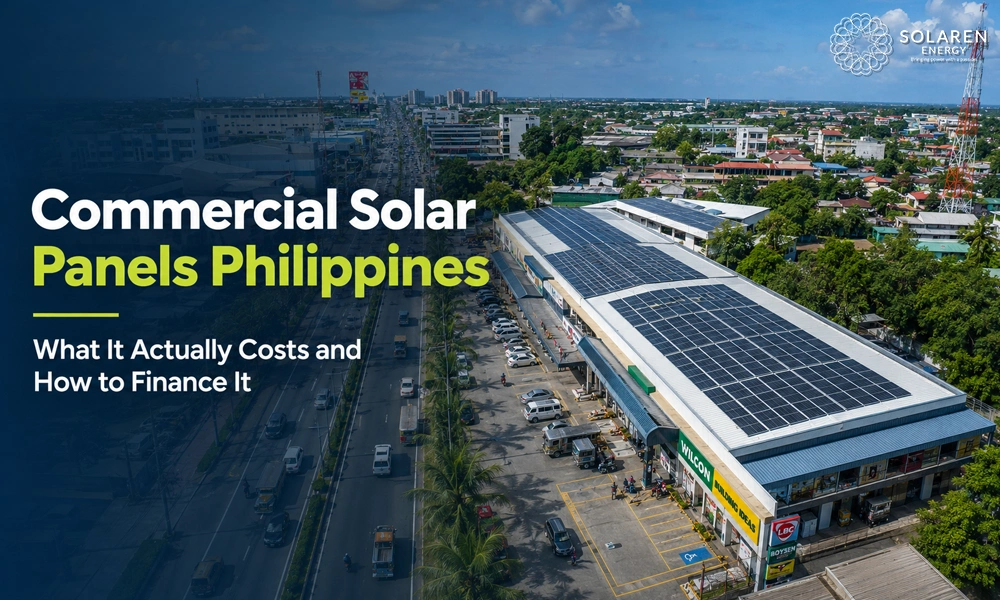
Most Philippine businesses that are seriously considering commercial solar panels reach the same point at roughly the same time. They have seen the financial case. They understand the payback logic. And then the proposals arrive and the numbers are harder to interpret than expected.
Three quotes for a 200kWp system. Three different prices. Three different equipment lists. Three different generation projections. Which one is actually a good value and which ones are not? That question is harder to answer than it looks, and the answer matters for the next twenty-five years.
This piece covers what commercial solar panels actually cost in the Philippines, what drives the variation between quotes, and how to finance the investment. For verified performance data and real case studies showing what correctly specified systems deliver over time, the companion piece on commercial solar panels Philippines covers that in detail.
What Commercial Solar Panels Actually Cost
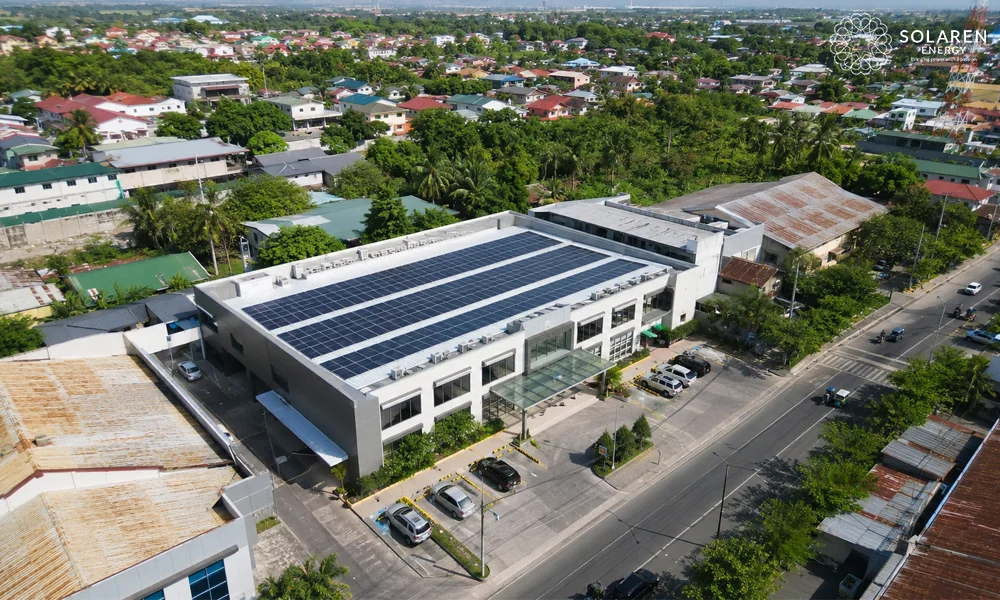
Turnkey commercial solar installations in the Philippines currently run between PHP 45,000 and PHP 70,000 per kilowatt-peak for most commercial and industrial systems. The range is wide because the variables driving cost are significant.
At the lower end of that range, you will typically find systems using Chinese-branded inverters with narrower grid tolerance windows, standard monofacial panels without bifacial uplift, simpler mounting systems that may not be rated for Philippine wind loads, and minimal commissioning documentation. The hardware works. The engineering may not be optimised for Philippine conditions.
At the upper end, you find systems using European inverters with documented Philippine field performance, bifacial glass-glass modules with verified factory test results, mounting systems structurally certified for local wind loads, and full commissioning testing, including export metering verification. The upfront cost is higher. The generation over twenty-five years is also higher, and the probability of the system performing as promised is significantly greater.
The practical cost benchmarks by system size are roughly as follows. A 50kWp commercial system runs PHP 2.5 million to PHP 3.5 million. A 100kWp system runs PHP 4.5 million to PHP 6.5 million. A 300kWp system runs PHP 13 million to PHP 18 million. A 500kWp system runs PHP 20 million to PHP 30 million. Per-kilowatt costs generally fall as system size increases because fixed costs, such as engineering, permitting, and mobilisation, are spread across a larger installation.
These figures cover panels, inverters, mounting, DC and AC cabling, switchgear, monitoring platform, installation, permits, and net metering application processing. A proposal that quotes significantly below these ranges is almost certainly cutting something. The question is what and whether it matters.
What Drives the Price Variation
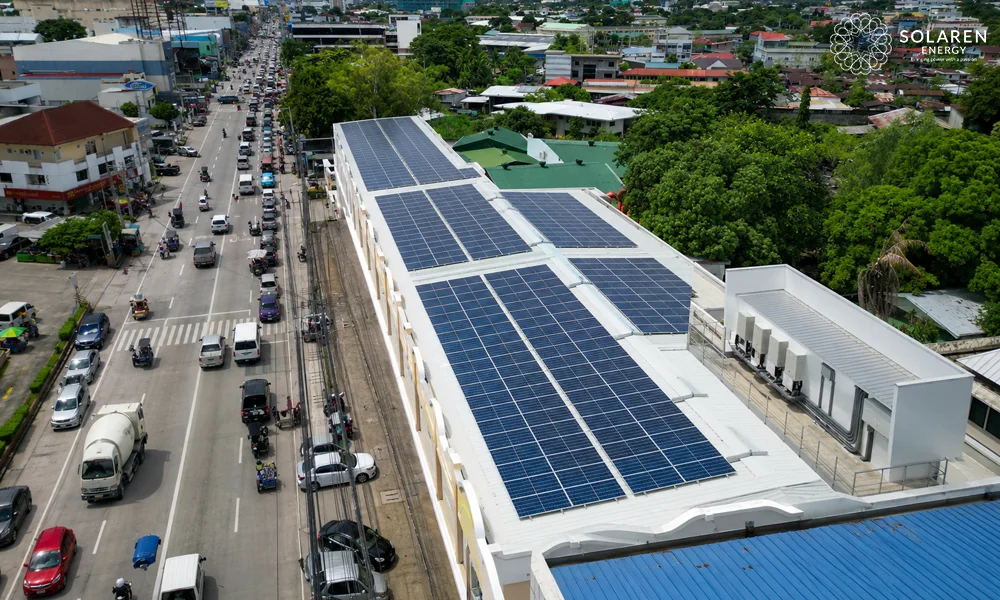
Understanding the four main cost variables changes how you read a proposal.
Inverter specification is the most consequential variable and the one most often used to reduce price without making the reduction obvious. Two proposals can list “hybrid inverter” or “string inverter” and mean very different things. An inverter specified for stable European grid conditions will trip more frequently on a Philippine cooperative feeder than one with a wider voltage and frequency tolerance window. The generation lost to those trips accumulates over the years. Ask for the inverter model, download the datasheet, and check the input voltage range and frequency tolerance. That comparison is more useful than the price comparison.
Module quality is the second major variable. Tier 1 is a financing classification, not a quality certification. Two Tier 1 modules can have meaningfully different temperature coefficients, the rate at which output drops above 25 degrees Celsius and in Philippine conditions where roof surface temperatures regularly exceed 60 degrees, that difference compounds into real money over the system life. Ask for the module datasheet. Check the temperature coefficient, the power tolerance, and the degradation warranty terms.
Cable sizing is the least visible cost variable and the one most consistently used to reduce proposal price below the market range. Undersized DC cables cause resistive losses that reduce generation permanently for the life of the installation. A system losing three to five percent of its DC output to cable resistance every day for twenty-five years loses a significant proportion of its lifetime generation. Ask for DC string cable cross-sections in the proposal. If a contractor cannot or will not specify these, that tells you something.
Engineering overhead, the cost of in-house licensed engineers doing the design, installation, and commissioning rather than subcontractors, is real and it shows in the price. A contractor who subcontracts installation can offer a lower price because the accountability gap between design and execution reduces their cost. It also reduces your protection if something is not done correctly.
The Real Cost of a Low Quote
A system that costs ten percent less but generates fifteen percent less over twenty-five years because the inverter was incorrectly specified is not the cheaper system. A system that costs eight percent less but whose net metering application was never properly processed loses the export credit value permanently for every month the approval is delayed.
The Tarlac poultry farm case study documents what a correctly specified 100kWp system delivers, PHP 5,759,547 in verified savings over forty billing months from a PHP 4 to 5 million investment. That is the benchmark for evaluating whether the generation projections in a proposal are realistic. A contractor whose simulation shows significantly higher generation from a comparable system on a comparable roof should be asked to explain the difference in detail.
Financing Options

Several financing paths are available for commercial solar installations in the Philippines and the right one depends on the business’s cost of capital and cash flow position.
Direct purchase produces the strongest financial return because there is no interest cost reducing the margin between avoided electricity cost and system cost. For businesses with available capital and a cost of capital below the solar IRR of 18 to 25 percent, this is the rational choice. The payback period is the shortest and the lifetime return is the highest.
Green loans from major Philippine banks are available for renewable energy projects. BDO, BPI, Metrobank, and several other institutions offer clean energy financing at rates currently ranging from five to eight percent per annum, depending on term and security. At those rates, the after-financing cost of ownership is still well below the avoided electricity cost for most commercial systems, meaning the investment is cash-flow positive from the first billing cycle after commissioning in most cases.
Lease-to-own arrangements spread payments across three to seven years and allow businesses to avoid a large upfront capital commitment. Monthly payments are typically structured below the expected monthly savings, producing positive cash flow from the start. The tradeoff is that the total cost over the lease term is higher than the direct purchase, and the financial return over the system lifetime is lower.
What to avoid is a long-term PPA from an unknown installer. The financial return is lowest because the developer captures most of the value. The risk is highest because your energy supply and net metering arrangement are tied to the continued operation of a company that may not exist in five years. The full case against PPA models for businesses with access to financing is set out in The True Cost of Free Solar.
What to Confirm Before Signing
Four things should be contractually specified before any commercial solar installation proceeds.
Engineering drawings signed by a licensed electrical engineer showing panel layout, string configuration, cable routing, mounting detail, and single-line electrical diagrams. The specific panel model and manufacturer with datasheet. The inverter model and manufacturer with datasheet. And a clear statement of which permits and approvals the contractor will process, in what sequence, and with what timeline commitment.
A contract that lists system size, total price, and equipment brands without these specifics is a purchase order. The details that are missing from a contract are almost always the details that cause problems later.
For a complete checklist of what to verify before signing a solar installation contract in the Philippines, the Top 10 Questions to Ask Before Signing covers the full evaluation framework.
Frequently Asked Questions
-
Why do commercial solar panel quotes vary so much for the same system size?
Because system size in kilowatts-peak tells you almost nothing about what is actually being proposed. Two quotes for 200kWp can use completely different inverter brands with different grid tolerance specifications, different module temperature coefficients, different cable sizing, and different mounting systems with different wind load certifications. The cheaper quote is almost always cheaper because something in that list was downgraded.
The question is whether the downgrade is visible at the point of comparison or only visible in the generation data three years from now. Asking for the inverter model, the module datasheet, and the DC cable cross-sections on every quote will explain most of the price difference.
-
Can a commercial solar installation be cash-flow positive from day one?
Yes, in many cases. When a green loan or lease-to-own arrangement is structured correctly, the monthly financing payment is lower than the expected monthly electricity savings. The system generates more value each month than it costs to finance. The exact position depends on the interest rate, the loan term, the system size, and how well the facility’s daytime consumption aligns with solar generation hours. A correctly prepared financial model showing monthly avoided cost against monthly financing payment will confirm whether day-one positive cash flow is achievable for your specific situation.
-
What happens to my solar financing if I sell the business or the property?
For owned systems, the solar installation transfers with the property as a fixed asset. The buyer inherits the system, the remaining warranties, and the net metering arrangement. The value of the system is a negotiating point in the transaction. For lease-to-own arrangements, the lease agreement typically needs to be novated to the new owner, which requires the financing institution’s approval. Most institutions accommodate this as a standard process.
For PPA arrangements, the contract transfers to the new owner under the terms of the original agreement, which may or may not suit the new owner’s preferences. This is one of the reasons ownership models are generally preferable to PPA arrangements for businesses that may change hands.