Across the Philippines, more companies are discovering that commercial solar panels are not a sustainability gesture. They are a financial decision with a calculable return, a defined payback period, and a lifetime of savings that compounds as grid tariffs rise. With electricity costs among the highest in Asia and the technology now mature and well-proven, the question for most Philippine businesses is no longer whether solar makes sense. It is why they have not acted on it sooner.
Why the Financial Case Is Stronger Than Most Buyers Expect
Electricity is one of the most significant and least controllable operating costs for a Philippine business. It rises with global fuel prices, with grid infrastructure charges, and with the growth of demand that the national grid is still catching up with. A correctly specified commercial solar installation converts a portion of that variable cost into a fixed one. The capital is spent once. After that, every kilowatt-hour the system generates is electricity that was not purchased from the grid at whatever the grid tariff happens to be that month.
For commercial and industrial facilities with significant daytime loads, solar generation maps directly onto consumption. Food manufacturing, poultry and livestock operations, retail with long trading hours, and industrial facilities running day shifts, these are the facilities where 70 to 85 percent of generation is consumed on site and the avoided grid cost is maximised. The math in those cases is straightforward. Annual generation multiplied by the grid tariff gives the avoided cost. Subtract minimal maintenance. Divide the capital cost by the annual saving. That is the payback period.
At current Philippine commercial tariffs, correctly specified systems in the right load profiles regularly achieve payback in three to four years. After payback, the electricity generated is essentially free for the remaining life of the installation, which on quality equipment, exceeds twenty-five years.
The ROI Numbers
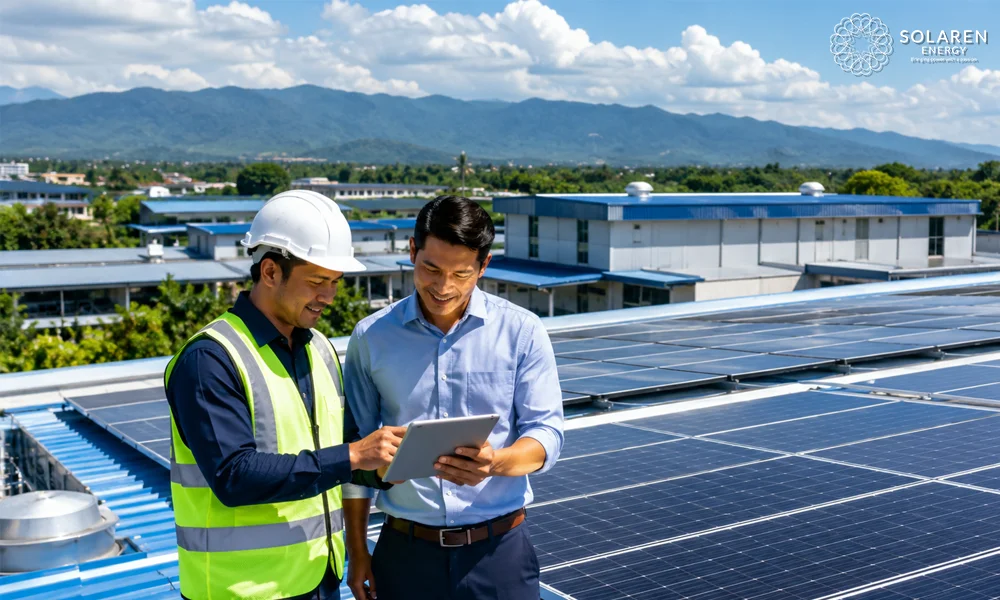
A 100kWp commercial solar installation in the Philippines typically costs between PHP 4.5 million and PHP 6.5 million, depending on equipment quality, site conditions, and mounting requirements. At a specific yield of 1,350 to 1,400 kWh per kilowatt-peak per year, achievable on a clean, unshaded roof in Luzon with correctly specified equipment annual generation runs approximately 140,000 kWh.
At a grid tariff of PHP 10.00 per kilowatt-hour, that generation represents PHP 1.4 million in avoided cost per year, assuming full on-site consumption. Subtract minimal maintenance costs and the payback sits at approximately 3.5 to 4.5 years, depending on the capital cost point. The internal rate of return over a twenty-five year service life, assuming flat tariffs, typically falls between 18 and 25 percent. Assuming tariffs continue on their historical upward trajectory, the return is higher.
These are not projections designed to make the numbers look attractive. They are the arithmetic of the technology applied to current Philippine conditions. The case studies below show what those numbers look like on real installations with verified performance data.
Case Study: Atlantic Grains – The Largest Grain Facility in the Philippines
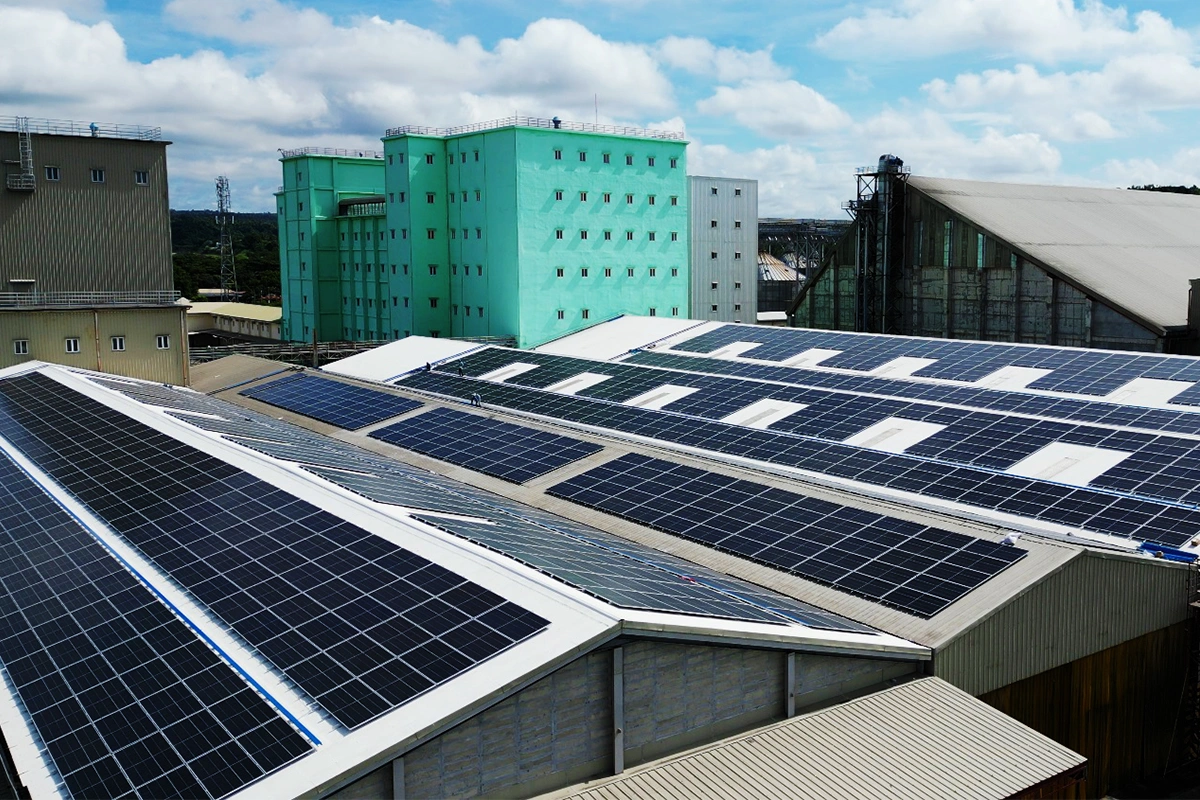
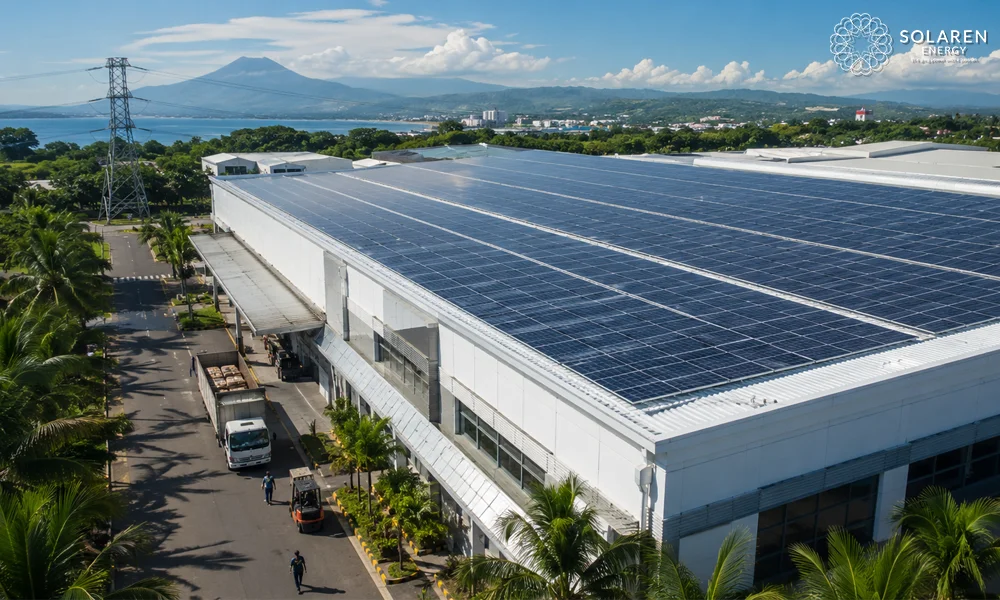
Atlantic Grains operates the largest grain importing, processing, and storage facility in the Philippines. The site runs silos, conveyor systems, process drying equipment, and continuous warehousing operations with a substantial daytime electrical load. The coastal location in Pangasinan adds environmental complexity, salt-laden air, high humidity, and the need for mounting and cabling systems engineered for corrosion resistance over a long service life.
The solar installation at Atlantic Grains now generates over two million kilowatt-hours annually. Capital payback runs to just over three years. At current tariff rates, the annual savings represent a significant reduction in one of the facility’s largest operating cost lines. For a facility sitting at the centre of national food supply logistics, the reliability of the energy system is not optional. The installation was engineered accordingly.
Case Study: Tarlac Poultry Farm – Verified Numbers from Forty Billing Months
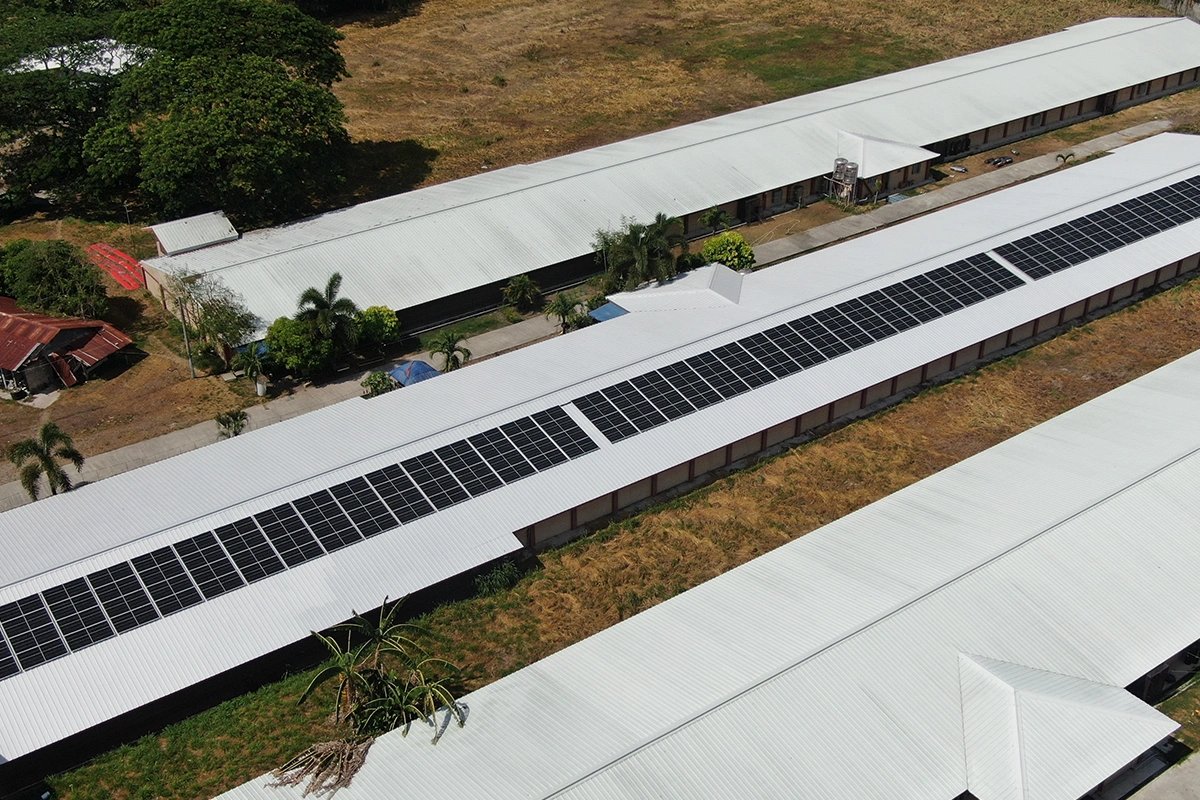
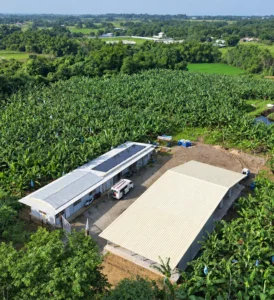
The Tarlac Mac Farm case study is the most thoroughly documented commercial solar installation in Solaren’s published portfolio. A 100kWp system was installed on a working poultry farm in Tarlac with bifacial TOPCon modules on a white reflective roof, an SMA CORE2 inverter specified with appropriate headroom, and a tap point positioned close to the main panel to minimise wiring losses.
The performance data is not a projection. It is drawn from forty billing months of verified utility bills reconciled against SMA EnnexOS meter readings with CT accuracy of plus or minus one percent.
Over those forty months, the system generated 458,456 kWh. Approximately 80 percent was consumed on site. The remaining 20 percent was exported under net metering at an average credit rate of PHP 6.81 per kilowatt-hour. Verified savings from reconciled utility bills: PHP 5,759,547 total, averaging PHP 147,681 per month. Equipment failure downtime across the entire forty-month period: zero.
The modelled bill without solar for the same period was PHP 19,289,896. The actual bill with solar was PHP 13,405,694. The difference is the savings. The specific yield of 1,375 kWh per kilowatt-peak per year is consistent with a correctly engineered system in Tarlac conditions. Full details are published at the poultry farm solar case study.
Case Study: Oishi – Multi-Phase Solar Across Food Manufacturing
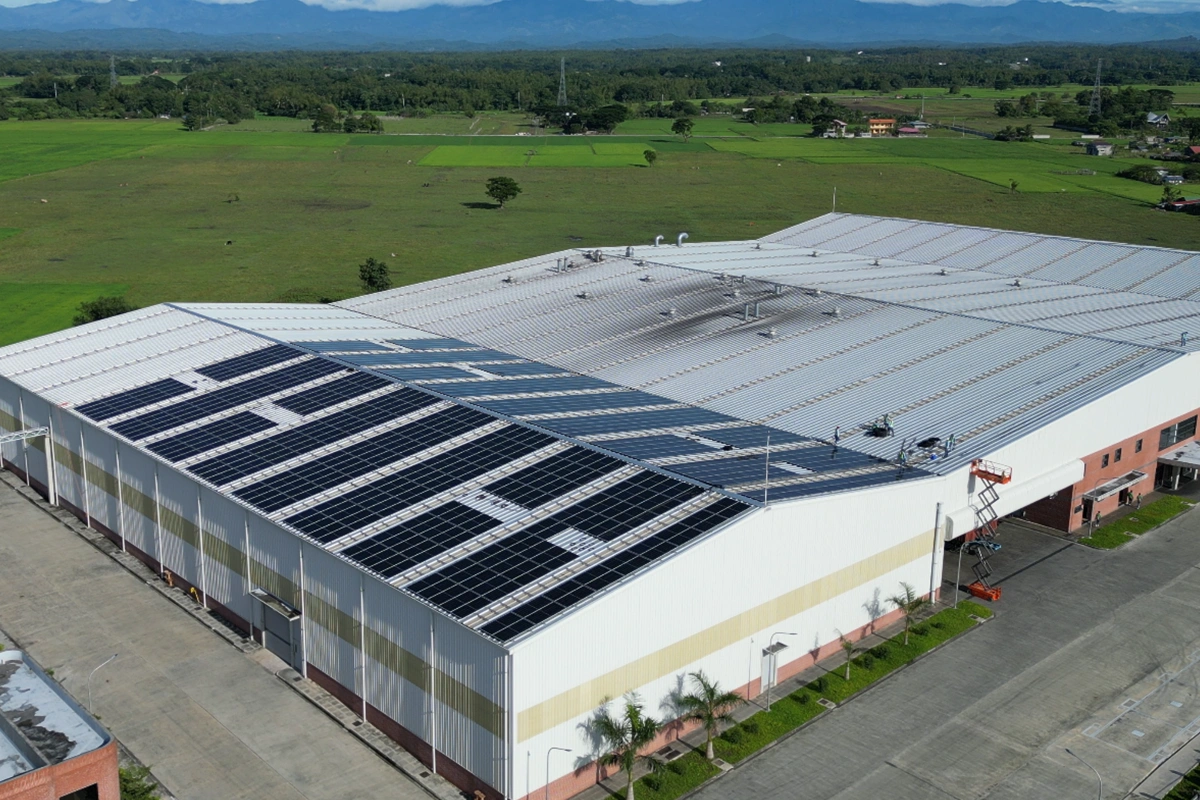
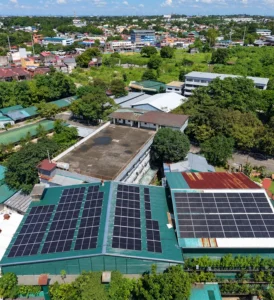
Oishi, one of the Philippines’ most recognised snack food brands under the Liwayway Marketing group, has completed multiple phases of solar installation across production facilities where cooking lines, process ovens, packaging equipment, and continuous manufacturing operations run throughout the day. The combined installed solar capacity across Oishi facilities now exceeds one thousand kilowatts.
Food manufacturing presents specific engineering requirements for a solar installation. Continuous daytime loads, process ovens and heating elements drawing significant current, and the need for electrical stability that does not interrupt production sequences all influence inverter selection, string configuration, and protection design. The Oishi installations were engineered around those requirements, not around a standard residential specification adapted to a larger roof.
The payback periods across the Oishi installations are measured in years not decades. The company’s own finance teams validated the numbers before any installation proceeded. For a business at that production scale, energy cost reduction at this level feeds directly into cost of goods sold and improves the margin on every unit produced.
What Determines Whether These Numbers Materialise
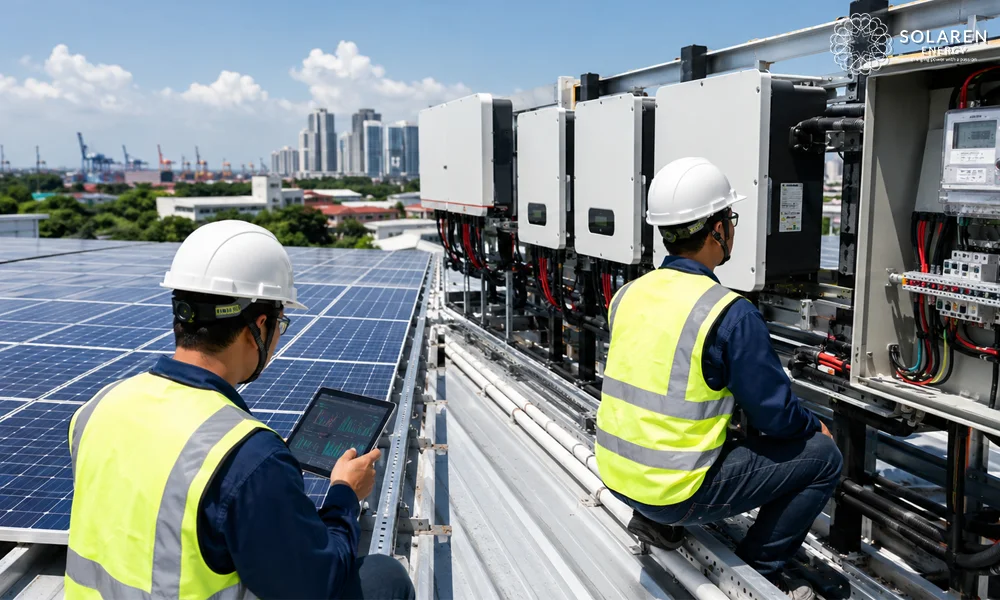
The ROI figures above are achievable. They are not automatic.
A system that underperforms its simulation by fifteen percent because the string configuration was designed incorrectly loses that fifteen percent permanently, every year, for the life of the installation. A system whose net metering application was never properly processed loses the export credit value permanently for every month the approval is delayed. A system installed with undersized DC cables loses three to five percent of its output to cable resistance every day for twenty-five years.
These are not rare edge cases. They are the difference between the case study numbers above and the results delivered by cheaper or less experienced contractors. The technology is the same. The engineering decisions around it are what determine whether the promised return shows up in the bill.
Solaren designs and installs every system using in-house licensed engineers. No subcontracting. SMA Germany inverters, LONGi, Trina Solar, and Sunova bifacial modules. Full commissioning testing, including export metering verification before handover. Net metering applications managed to approval across every distribution utility Solaren works with.
For the financial modelling framework behind these numbers, The Ultimate Guide to Commercial Solar ROI in the Philippines gives the methodology for evaluating any commercial solar investment against real performance benchmarks.
Frequently Asked Questions

-
What is a realistic payback period for commercial solar panels in the Philippines?
For facilities with significant daytime loads and consumption profiles that align well with solar generation hours, payback periods of three to four years are regularly achieved at current tariff rates and system costs. The Tarlac poultry farm case study documents a system where verified savings of PHP 147,681 per month against a capital cost in the PHP 4 to 5 million range produces a payback of approximately three years.
Facilities with lower load alignment, meaning more of their consumption happens at night or on weekends, will see longer payback periods because a greater proportion of generation is exported at credit rates rather than consumed at full avoided-cost value.
-
How do I know if the ROI projections in a solar proposal are realistic?
Ask the contractor to show you the generation simulation file, not just the annual kWh estimate on the cover page. The simulation should specify the weather dataset used, the performance ratio assumed, and the shading analysis conducted for your specific roof. Ask for the module datasheet and check the temperature coefficient; high ambient temperatures reduce output in ways that aggressive simulations understate. Ask for actual generation data from comparable completed installations, not illustrative projections.
And ask specifically whether the payback calculation assumes full on-site consumption or includes export at the lower net metering credit rate. A contractor who cannot answer these questions in detail has not done the engineering work the proposal implies.
-
Does commercial solar still make financial sense if my business is closed on weekends?
Yes, but the calculation changes. A business closed on weekends generates solar power on those days that cannot be consumed on site. That surplus is exported to the grid under net metering and earns a credit at the utility’s approved export rate, which is typically lower than the retail tariff. The financial return is still positive, net metering credits have real value and accumulate across the year.
But the payback period will be longer than for a facility running seven days a week that consumes most of what it generates. The right system size for a business closed on weekends is generally smaller than for an equivalent facility running continuously, because oversizing increases the proportion of generation that earns the lower export credit rate rather than the full avoided-cost rate.