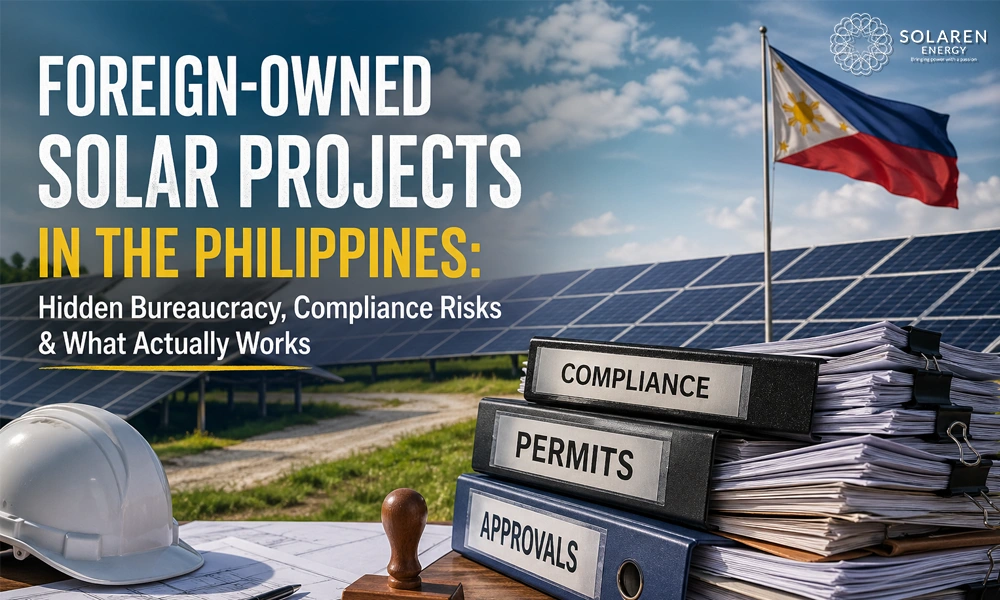
The Philippines opened solar energy projects to 100 percent foreign ownership in 2022. Before that, the limit was 40 percent, and the legal argument for lifting it was genuinely interesting. The Department of Justice ruled that sunlight is not a natural resource in the constitutional sense because it cannot be appropriated or owned. The sun belongs to everyone. Therefore, foreign companies can harness it without restriction.
That is the legal position. The operational reality is considerably more complicated, especially for Foreign-Owned Solar Projects entering the Philippine market.
Foreign companies arriving in the Philippines with a solar project in mind, whether for their own facility or as part of a broader energy strategy, routinely underestimate what is involved. Not because the market is unwelcoming. It is not. But because the gap between what the law says and what actually happens on the ground in the Philippines can be wide enough to swallow a project timeline whole.
The Bureaucracy Is Real and It Is Not Linear
This is the thing that catches most foreign operators off guard. They expect a process. They find a process that does not always follow the sequence it is supposed to, that involves agencies with overlapping jurisdiction, and that can move quickly in one area and stall completely in another with no obvious explanation.
Delays in Philippine energy projects commonly arise from complex administrative and bureaucratic processes, including securing permits and navigating procurement procedures. That applies to large utility-scale developments. For commercial and industrial rooftop installations, the same dynamic plays out at a smaller scale but with no less friction.
Permits, electrical inspections, grid connection applications, net metering processing, and local government clearances do not always move in the same direction at the same time. An application that is straightforward in one municipality can take months in another because the local building official has a different interpretation of what is required. Makati and Imus in Cavite, for example, require submission of contractor credentials and qualifications before work permits are granted. Most foreign operators do not know this until they hit the wall.
The companies that navigate this well are the ones that arrived with a local EPC partner who has done it many times before. The ones that struggled almost always tried to manage the process themselves, or brought in a home-country contractor who had never dealt with a Philippine government office.
Sending Your Home Country Contractor Is Usually a Mistake
We see this more with Chinese companies than with Korean or Japanese investors, who tend to arrive with more awareness of local conditions. A Chinese manufacturing facility relocating to the Philippines will sometimes bring a solar contractor from home. The contractor knows the technology. They do not know the Philippine Electrical Code, the ERC net metering requirements, the PCAB licensing system, or how to engage a distribution utility for grid connection.
The result is a project that stalls at the compliance stage, or worse, gets installed without the required permits and then cannot be connected to the grid. In some cases, systems have been installed and commissioned without net metering approval, fed generation back into the grid through defective limiting hardware, and ended up with the meter running in the wrong direction. Instead of earning credits, the client was billed for the exported energy. That is a significant and entirely avoidable financial loss.
Korean and Japanese companies tend to do better. Not because their contractors know the Philippines better, but because they are more likely to ask the right questions early and engage local expertise before assuming the process works the same way it does at home.
How It Works When It Is Done Correctly
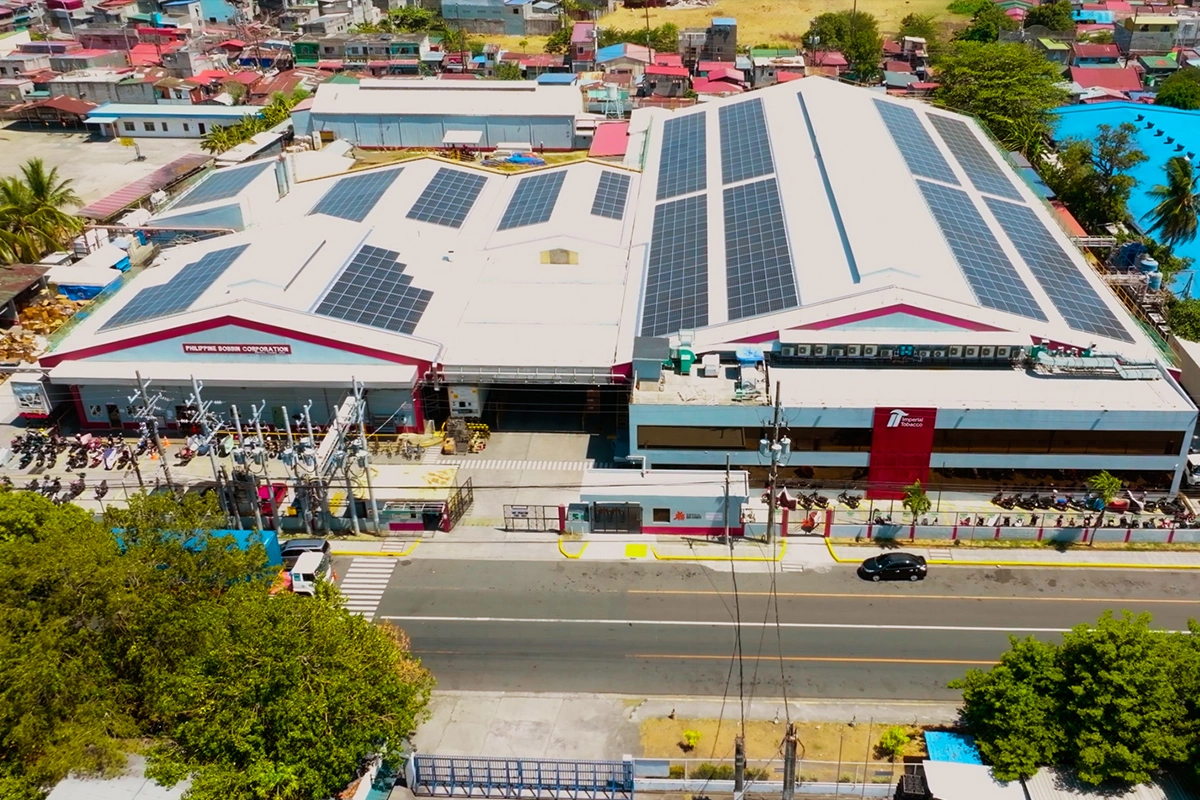
Philippine Bobbin Corporation, a subsidiary of Imperial Tobacco PLC, is a good illustration of what successful foreign-funded solar looks like in the Philippines. The compliance framework, the governance standards, and the reporting requirements all originated from the UK parent company. The standards were strict, the documentation requirements were thorough, and the expectations around accreditation and legal compliance were non-negotiable.
Solaren executed the installation. But the discipline that made the project work came from a client who understood that operating as a foreign subsidiary in the Philippines requires a higher standard of compliance rigour than a purely local operator might apply. The local EPC handled the Philippine-specific process. The parent company’s governance framework ensured nothing was cut short. That combination is exactly how foreign-funded solar projects should work.
The Corporate Structure Question
Foreign investors in the Philippines sometimes find that exit disputes and asset ownership questions are harder to resolve than they expected, particularly when a local partner has stronger connections to domestic regulatory authorities. This applies directly to solar asset situations.
While 100 percent foreign ownership is now legally permitted for solar energy development, a foreign company installing a rooftop solar system on a facility it leases rather than owns faces a different set of questions. Who owns the solar asset? What happens to the system if the lease ends? Can the asset be repatriated or sold? How is it treated on the Philippine balance sheet versus the parent company accounts?
These are not hypothetical questions. Ownership disputes over solar assets have arisen in situations where the corporate structure was not clearly defined before installation began. A foreign-owned operating company, a Philippine-registered holding entity, a leased facility, and a solar system installed on that facility can create a genuinely complicated picture when the relationship between any of those parties changes.
Get legal advice specific to the Philippines before the contract is signed. Not general Southeast Asia advice. Philippines-specific advice from someone who understands how asset ownership works under local law for a foreign-controlled entity.
Accreditation Matters More Than Most Foreign Clients Expect
The Philippine Contractors Accreditation Board licenses construction contractors. PCAB accreditation is a legal requirement for commercial solar installation in the Philippines, and relatively few solar companies actually hold it. The DOE maintains its own accreditation register for renewable energy contractors.
In practice, many solar installations proceed without one or both of these. Utilities sometimes insist on accreditation before they will process a grid connection or net metering application. Local government units in certain areas will not issue work permits to unaccredited contractors. When those issues arise mid-project, the cost of resolving them falls on the client.
A foreign company commissioning a solar installation should verify that their chosen contractor holds current PCAB accreditation and DOE registration before signing anything. This step is critical for avoiding delays in Foreign-Owned Solar Projects.
What Actually Works
The foreign companies that execute solar projects smoothly in the Philippines follow a consistent pattern. They engage a locally accredited EPC with a documented track record on commercial and industrial installations. They allow realistic timelines for permitting and grid connection, which in the Philippines means months, not weeks for a first installation. They do not assume that speed is possible by throwing resources at the process. And they do not send their home-country team to manage a process that requires local relationships and local knowledge to navigate.
The Philippine solar market is genuinely attractive. The irradiance is excellent, the commercial case for solar is strong, electricity costs are among the highest in Southeast Asia, and the regulatory framework for foreign participation has never been more open. None of that means the process is simple. It means the opportunity is real for those who approach it correctly.
Solaren has worked with foreign-funded clients across manufacturing, food processing, automotive, and retail. The projects that went smoothly were the ones where the client came in with realistic expectations about the local environment and a willingness to let local expertise lead the compliance and permitting process. The ones that did not go smoothly almost always involved someone who assumed the Philippines would work the way their home country does.
It does not. And that is not a criticism. It is just the starting point for any successful project here.
For commercial and industrial solar installations across any ownership structure, commercial solar installation Philippines covers the process from site assessment through grid connection. And for a broader look at what accreditation and compliance actually mean in practice, choosing a solar EPC in the Philippines is worth reading before any contract is signed.
Frequently Asked Questions
-
Can a fully foreign-owned company install and own a solar system in the Philippines?
Yes. Since 2022, 100 percent foreign ownership in solar energy projects is legally permitted following a Department of Justice ruling that solar energy resources are not natural resources in the constitutional sense. However, owning the solar asset as a foreign entity operating through a leased facility, a Philippine-registered subsidiary, or a joint venture structure involves additional legal considerations around asset ownership, repatriation, and what happens if the corporate structure changes. Get Philippines-specific legal advice before the contract is signed.
-
Do Philippine local government units require special permits for solar installations?
Yes, and the requirements vary significantly by location. Some LGUs, including Makati and Imus in Cavite, require submission of contractor credentials and accreditation documents before work permits are issued. Others have simpler processes. A locally accredited EPC with experience in your target location will know what is required and how long it typically takes. Assuming the permitting process is uniform across the Philippines is one of the most common and costly mistakes foreign operators make.
-
Why do Korean and Japanese companies tend to have fewer problems with Philippine solar projects than other foreign investors?
In our experience, Korean and Japanese operators arrive with a greater awareness that local conditions differ from their home market and a greater willingness to engage local expertise early. They ask more questions before starting and are less likely to assume that their home-country approach translates directly. Companies that have operated in other Southeast Asian markets before coming to the Philippines also tend to navigate the process more smoothly, because they already understand that regional familiarity is not the same as country-specific knowledge.