When people compare solar companies in the Philippines, they look at price, equipment brands, project portfolio, and how confident the salesperson seems. Accreditation rarely gets discussed. Most buyers do not know to ask about it. And most solar companies quietly prefer it that way.
This is worth understanding before you sign anything.
What Accreditation Actually Means
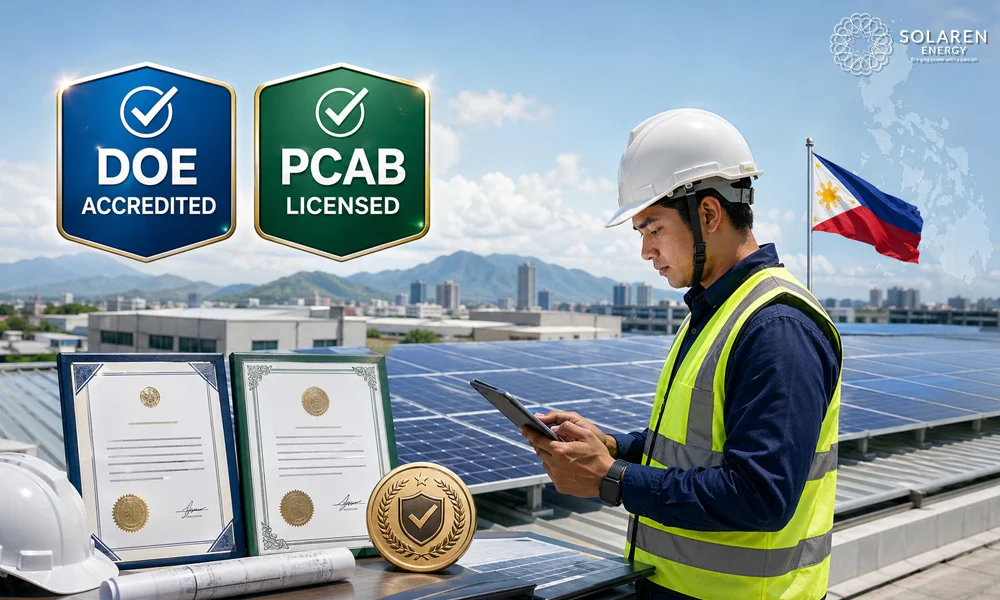
There are two bodies whose credentials matter for commercial solar installation in the Philippines.
The Department of Energy maintains an accreditation register for renewable energy contractors. DOE accreditation signals that the company has met minimum requirements around technical capacity, financial stability, and regulatory compliance for energy work. It is not a rubber stamp. Companies that hold it have gone through a process that most have not.
The Philippine Contractors Accreditation Board is the other one. PCAB licensing is a legal requirement for construction contractors in the Philippines, which includes solar installation. It is not optional. A contractor without PCAB accreditation is not legally permitted to execute a commercial solar installation in this country.
That last sentence tends to surprise people. Because a significant number of solar installations in the Philippines are completed by companies that do not hold current PCAB accreditation, some of those companies do genuinely good and reliable work. Their engineers are competent, their equipment is quality, and their clients are satisfied. That happens. But for every one of those companies, there are roughly fifty others operating without accreditation whose work does not meet standards. The accreditation requirement exists precisely because the consequences of poor installation, from fire hazards, safety, structural failure to compliance exposure, are serious.
The problem is that you cannot tell which kind of unaccredited company you are dealing with until after the installation is done. Accreditation does not guarantee quality. Nothing does. But it is a minimum threshold that filters out a significant proportion of the fly-by-night operators. That filtering has value even if it is not visible.
Where It Actually Matters on the Ground
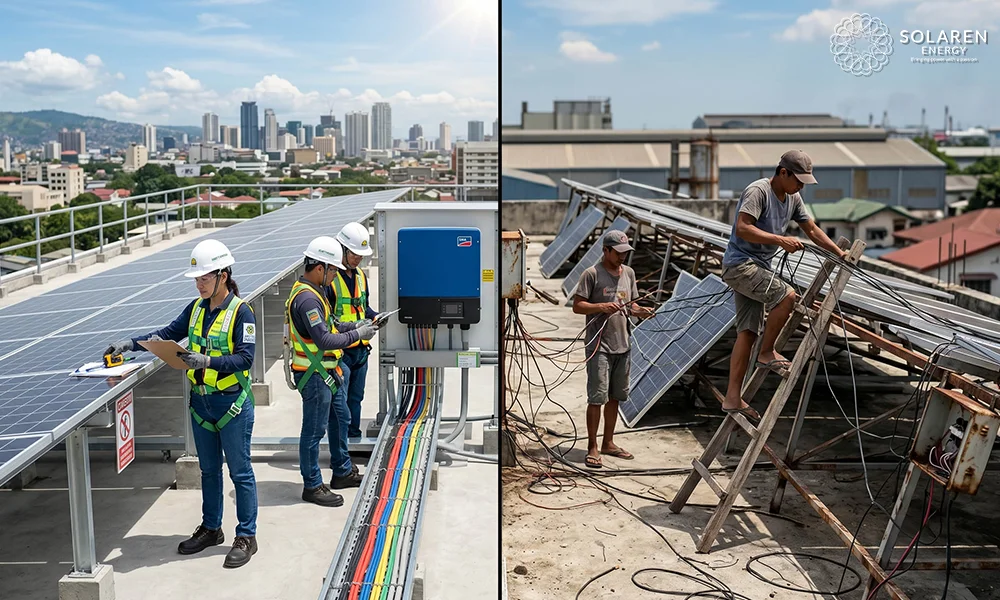
Accreditation is not just a regulatory formality. It has practical consequences that show up at specific points in a solar project.
Some utilities will not process a grid connection or net metering application for a system installed by an unaccredited contractor. They request proof of contractor credentials as part of the interconnection paperwork. If the contractor does not have them, the application stalls. The system may be physically installed and generating, but it cannot be legally connected to the grid under net metering until the credentials issue is resolved. In some cases, it never is.
Local government units add another layer. Makati City and Imus in Cavite both require submission of contractor accreditation and engineering credentials before a work permit is issued. A company without the right documentation cannot legally begin installation in those jurisdictions. This is not obscure fine print. It is a requirement that stops projects cold when it is encountered for the first time.
We have worked in both locations. The credential submission is a standard part of our process. For an unaccredited contractor encountering it for the first time, it is a problem they cannot easily solve.
Why Insurance Matters When Choosing a Renewable Energy Company
This is the angle most buyers never consider until something goes wrong.
A commercial solar installation is a construction project on an occupied building. Things can go wrong during installation. A worker can be injured. Equipment can be damaged. In extreme cases, an installation defect can potentially cause a fire or structural problem.
When something goes wrong on a project executed by an unaccredited contractor, the insurance picture becomes complicated. The contractor’s liability coverage, if they have any, may not respond to a claim arising from work they were not legally permitted to perform. The building owner’s property insurance may similarly have questions about coverage for damage caused by work done without proper permits and credentials.
We are currently fixing a system on a site where the original installation was done without proper compliance documentation. The wiring defects created a genuine fire hazard. The original contractor has not engaged. The client has no contractual basis to compel them to because the contract said nothing about compliance obligations. The insurance position is unclear. This situation did not have to happen.
An accredited contractor carries current liability insurance as a condition of maintaining accreditation. The coverage is real and the contractor is legally permitted to perform the work. When something goes wrong, which in construction it sometimes does, there is a clear chain of responsibility. Customers should ask for “Contractors All Risks” Insurance in addition to any other standard insurance.
What Accreditation Represents in a Renewable Energy Company
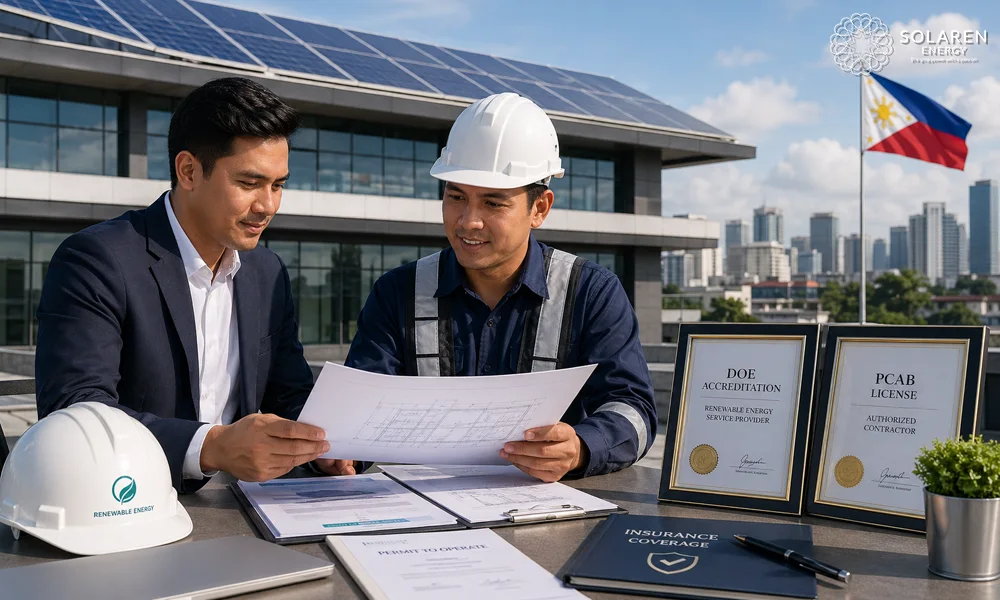
Solaren holds both DOE accreditation and current PCAB licensing. This is not as common as it should be in the Philippine solar market. It means every installation Solaren completes is executed by a contractor that is legally permitted to do the work, carries the required insurance, and can be held to account through the regulatory framework if something is not done correctly.
It also means the permits get processed. The grid connections go through. The net metering applications are not held up because a utility clerk found a problem with the contractor’s credentials. In jurisdictions like Makati and Imus, where credentials are checked before a spade goes in the ground, the project can actually start.
Solaren also carries a Dun and Bradstreet rating, the internationally recognized business credibility and financial health assessment used by multinational corporations and institutional procurement departments worldwide. For foreign-funded companies, large corporate clients, and procurement teams whose governance standards require verified supplier credibility, this is a level of institutional transparency that very few Philippine solar contractors can offer.
Beyond the legal and administrative dimensions, accreditation creates a different kind of accountability. A company that has invested in building and maintaining its accreditation standing has something to protect. That is nothing. An unaccredited company operating in a grey area has less to lose if a project goes wrong and the client is unhappy. The consequences of poor work fall entirely on the client rather than being shared with the contractor through a regulatory framework that has teeth.
The Market Reality
The honest picture of the Philippine solar market is that accreditation is not the norm. There are good unaccredited companies. There are bad unaccredited companies. There are many more of the latter than the former.
The buyer who does not ask about accreditation is relying entirely on their ability to distinguish between them from a sales pitch, a website, and a proposal document. That is a difficult judgment to make correctly, and the consequences of making it incorrectly sit entirely with the buyer.
The buyer who asks for PCAB and DOE accreditation certificate numbers, checks them, and uses accreditation as a minimum threshold for shortlisting has already filtered out a significant proportion of the risk before any other evaluation begins. It takes five minutes. It is worth doing every time.
For a broader look at how to evaluate solar contractors in the Philippines before signing a contract, choosing a solar EPC in the Philippines covers the full evaluation framework. And the reviews page carries verified client feedback across Solaren’s commercial and industrial portfolio for anyone who wants to see what an accredited, compliant installation looks like in practice over time.
Frequently Asked Questions
-
How do I check if a solar contractor holds current PCAB accreditation?
Ask the contractor directly for their PCAB license number and category. PCAB maintains a public registry and you can verify the license status, category, and expiry date. Do the same for DOE accreditation. Both checks take less than five minutes and tell you immediately whether the contractor is legally permitted to execute the work. A contractor who becomes vague or evasive when asked for these details is telling you something important.
-
Does using an unaccredited solar contractor affect my building permits?
In some local government units yes, significantly. Makati and Imus in Cavite both require contractor credential submissions before work permits are issued. An unaccredited contractor cannot satisfy those requirements, which means the project cannot legally begin in those jurisdictions. Other LGUs have less stringent checking processes, but the legal requirement for PCAB accreditation applies nationally regardless of whether the local office enforces it.
-
What happens if a solar installation causes damage and the contractor is unaccredited?
The liability picture becomes genuinely complicated. The contractor’s insurance may not respond to a claim arising from work they were not legally permitted to perform. The building owner’s property insurer may have questions about coverage for damage caused by unpermitted work. And the client may have limited contractual recourse if the installation contract did not specify compliance obligations. Accreditation is not a guarantee that nothing will go wrong. But it ensures there is a clear legal framework and functioning insurance coverage when it does.