We have spoken to a lot of factory electrical engineers in the Philippines over the years. And one thing comes up almost every time. When you ask what their biggest power problem is, they say brownouts. The outages. The generator starts. That is what keeps them up at night.
Which is fair. Brownouts are real and they are costly. But somewhere in those same discussions, if you keep asking, a different list starts to emerge. Recurring drive trips that maintenance cannot explain. Transformers running hot for no obvious reason. Motors are failing earlier than they should. Neutral cables that get warm during production. Capacitor banks that keep blowing.
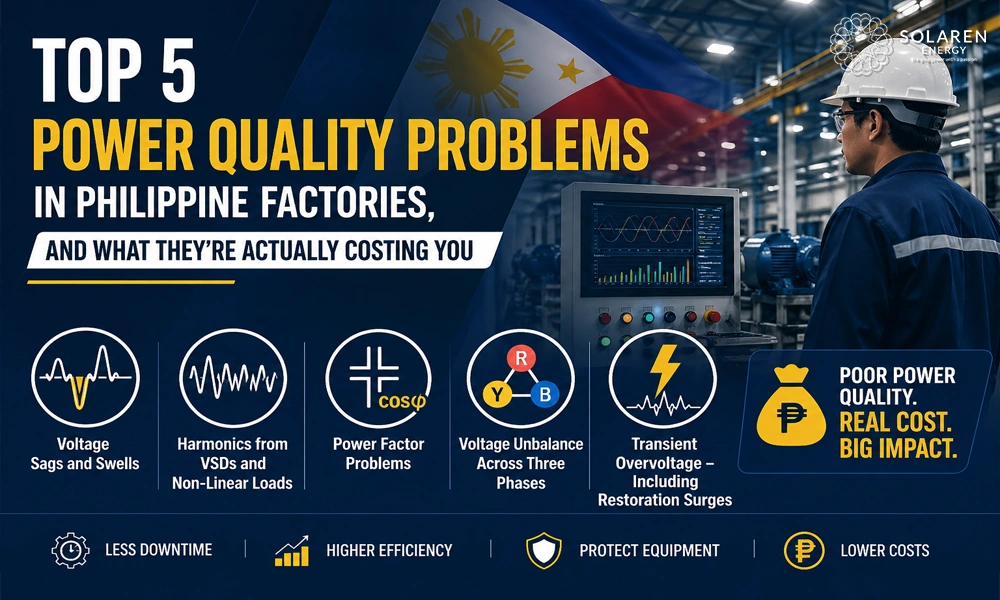
5 Major Power Quality Problems in Philippine Factories

These are power quality problems. They are not brownouts. They are much less obvious than brownouts, less visible, and in many facilities, they are costing more. Costs are spread across maintenance budgets, equipment replacement cycles, and electricity bills in ways that nobody has connected back to the supply.
Here are the five we encounter most often.
1. Voltage Sags and Swells
A voltage sag is a brief drop in supply voltage, typically lasting less than a minute, that falls outside the normal operating range. A swell is the opposite. A brief overvoltage. Both happen constantly on Philippine industrial grids, especially in provincial areas served by long distribution lines and older substation equipment.
The cause is usually something upstream. A large motor is starting at a neighboring facility. A fault on the feeder that the utility clears in a few cycles. A sudden load change somewhere on the network. The duration is short enough that nobody really notices. The lighting flickers. Maybe a fan momentarily slows. Then everything seems fine.
What is not fine is what happened inside the sensitive equipment during those two or three cycles. Variable speed drives, PLCs, and process controllers are intolerant of voltage sags. A drop of fifteen percent for two cycles can trip a drive or reset a controller mid-process. If that happens during a weld, a cut, or a critical stage of food production, the restart cost is disproportionate to the duration of the event.
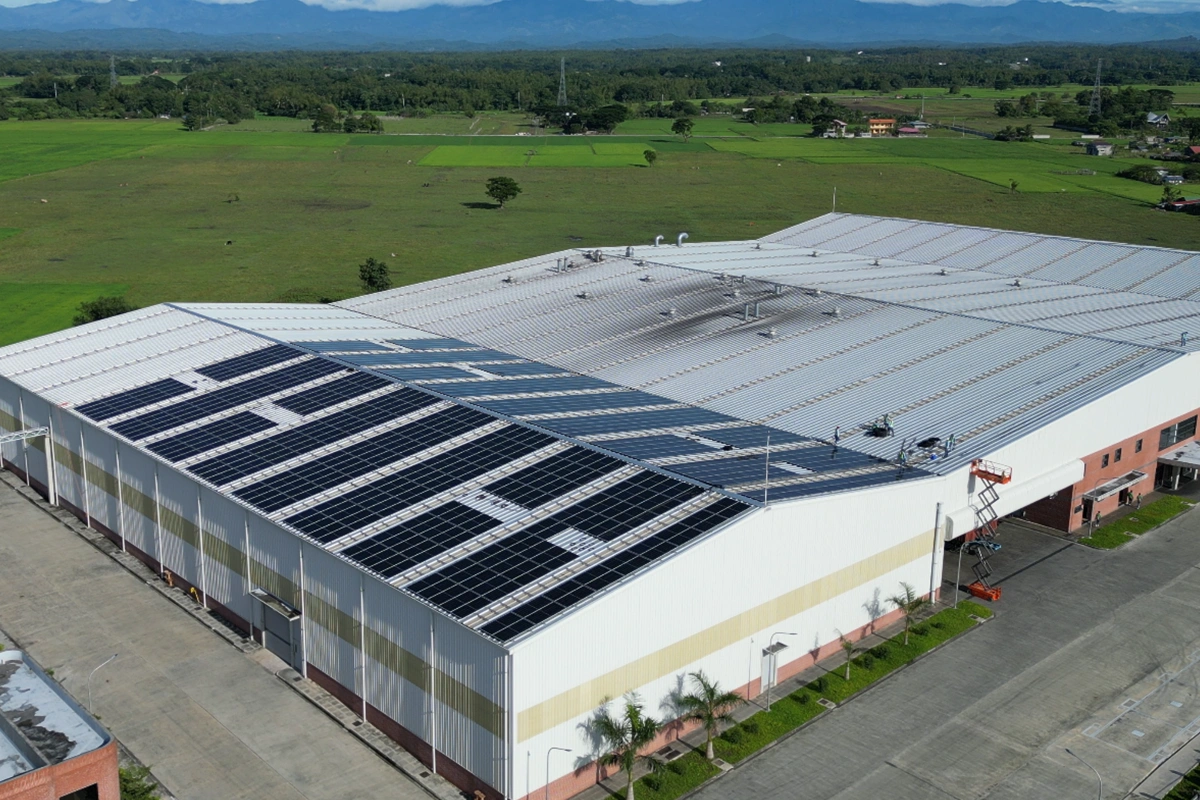
Oishi’s Iloilo facility in Pavia operates in an area where voltage instability is a known characteristic of the local grid. Inverter selection for the Oishi Iloilo installation was partly driven by the need for equipment that could tolerate supply-side irregularities without tripping production lines. That is a design decision that most standard solar specifications do not think about. It matters enormously on a live manufacturing site.
2. Harmonics from Variable Speed Drives and Non-Linear Loads
This one surprises factory engineers more than anything else on this list.
Modern factories run a lot of variable speed drives. On conveyors, compressors, fans, pumps, and packaging lines. VFDs are genuinely useful because they are efficient, controllable, and now essentially standard on any modern motor installation. They are also non-linear loads that inject harmonic currents back into the electrical system.
Harmonics are distortions of the 60Hz supply waveform. The third, fifth, and seventh harmonics are the most common in industrial environments. They cause transformers to run hotter than their nameplate rating suggests they should. They cause neutral conductors to carry currents they were never sized for. They accelerate capacitor bank failures. And they cause other sensitive equipment on the same system to behave unpredictably in ways that are genuinely hard to diagnose without a power quality analyzer on site.
The maintenance team replaces the capacitor bank. It fails again six months later. They replace the transformer. Nobody connects either event to the harmonics being injected by the VFD installation that went in two years ago.
Harmonic filters, passive or active, depending on the load mix, fix this. For sites with significant VFD loading, this is not an optional extra. And when Solaren assesses an industrial site for solar, harmonic loading is part of that assessment. A solar system feeding into a harmonically distorted network without accounting for it will underperform and can make existing problems worse. Most people fail to understand this.
3. Power Factor Problems
Power factor is the ratio of real power, the work your equipment actually does to apparent power, which is what the meter records. A power factor of 1.0 means every unit of current drawn is doing useful work. At 0.75, roughly a quarter of the current drawn is circulating uselessly, heating cables and transformers.
Most Philippine industrial facilities with significant motor loads run somewhere between 0.70 and 0.85. The utility knows this. That is why commercial and industrial tariffs include power factor penalty clauses. Fall below the threshold, typically 0.85, and you pay a surcharge every month on top of your consumption charges.
On a mid-sized manufacturing facility, that penalty adds up. Five to fifteen percent on the monthly bill is not unusual. That is money going to the utility for electricity that is doing no useful work in your facility at all.
Power factor correction capacitor banks fix this and payback periods are short. For any site where solar is being considered, power factor correction should be considered at the same time. Improving your generation economics while a power factor penalty silently erodes them is a missed opportunity that we see more often than we should.
4. Voltage Unbalance Across Three Phases
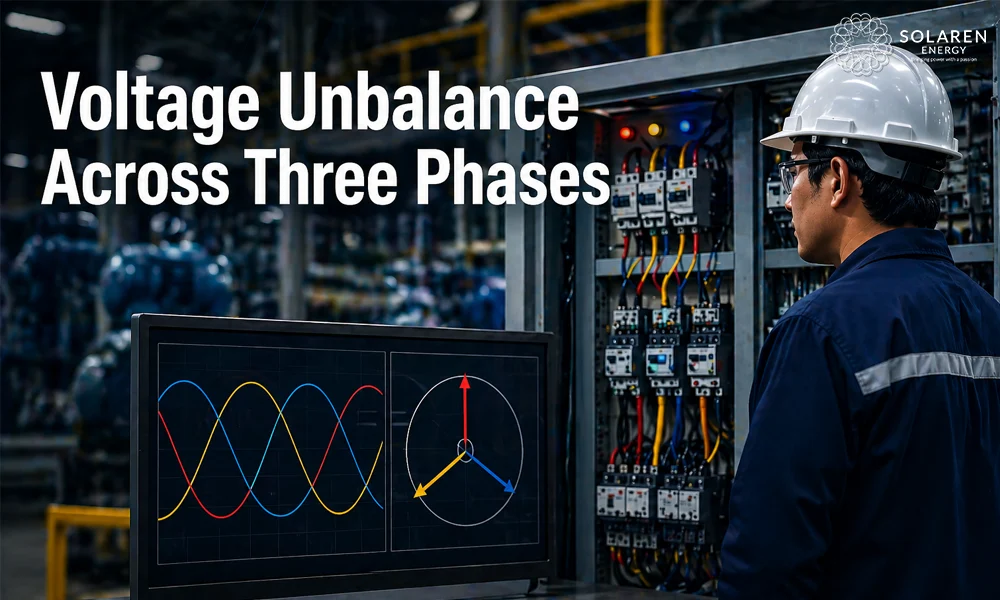
Three-phase supplies should deliver equal voltage across all three phases. In practice, especially at the end of long distribution lines or in older industrial estates where the load mix has shifted since the infrastructure was built, they frequently do not.
Voltage unbalance at even two or three percent causes three-phase motors to draw unequal currents across phases. The motor runs hotter than it should. Insulation degrades. Bearing life shortens. The motor fails earlier than its nameplate rating suggests it should, and the maintenance team attributes it to duty cycle or load conditions rather than supply quality because nobody has put an analyzer or logger on the supply.
We have found voltage unbalance as the primary cause of recurring motor failures on multiple industrial sites. The fix is sometimes just simple load rebalancing at the distribution board. Sometimes it requires engaging the utility about the upstream supply. Either way, it starts with measurement, and measurement starts with knowing to look.
5. Transient Overvoltage – Including Restoration Surges
Every time a large motor starts or stops, a capacitor bank switches, or a protection device clears a fault on the network, a transient overvoltage is generated. These events are brief, microseconds to milliseconds, but the voltage peaks can be several times the normal supply level.
The one that causes the most damage on Philippine industrial sites is one that most engineers are very aware of but cannot always protect against: the restoration surge. When supply is restored after a brownout, the sudden return of voltage to a system that has been dead. With motors stopped, capacitors discharged, and everything waiting to restart simultaneously, this creates a surge that travels through the distribution system. Sensitive electronics, VFD input stages, and instrumentation take the hit. The brownout lasted twenty minutes. The restoration surge lasted microseconds. The PLC that failed the following week was damaged in those microseconds.
Surge protection devices at the main distribution board and at critical equipment panels are the baseline. For facilities running sensitive process control equipment, power conditioning upstream of that equipment is worth serious consideration.
This is directly relevant to solar installations. When a solar system reconnects to the grid after an outage, the interface between the inverter and the distribution system needs proper transient protection. Built to Last: Engineering Solar Resilience for the Philippine Climate covers how these protection decisions get made on sites where grid quality is a known variable.
The Common Thread
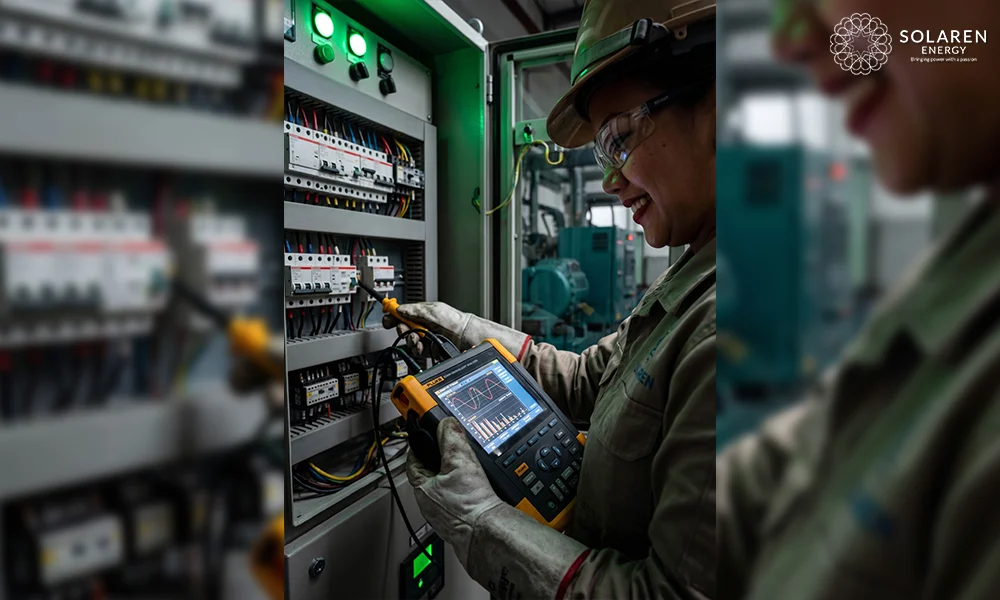
None of these problems are obvious. They show up as maintenance costs, as unexplained equipment failures, as process inconsistencies, as electricity bills that are higher than they should be. By the time the root cause is identified, the damage has accumulated.
A power quality assessment, a logger on the supply for a defined period, changes the picture completely. It gives you data rather than assumptions and makes every subsequent decision about solar, protection equipment, and grid interface design more accurate.
For industrial operators thinking about solar in the context of real Philippine grid conditions, industrial solar power systems designed around what is actually on your supply deliver results that a generic specification cannot.
Frequently Asked Questions
-
How do I know if my factory has a power quality problem?
The signs are usually already there, you just may not have connected them to the supply. Recurring drive trips with no obvious cause, transformers or neutral cables running warmer than expected, capacitor banks failing repeatedly, motors reaching end of life earlier than their nameplate rating suggests, and electricity bills with power factor penalty charges you assumed were unavoidable. Any one of these on its own might have another explanation.
Two or three together almost always point to a supply quality issue. The only way to know for certain is to put a power quality analyser or data logger on the incoming supply for a defined period and measure what is actually happening. It is a modest cost and it changes every subsequent decision about maintenance, equipment specification, and solar system design.
-
Does a solar installation make power quality problems better or worse?
It depends entirely on how the system is designed. A solar installation that is assessed and specified correctly for your site conditions, including harmonic loading, voltage tolerance, and transient protection, will not worsen existing power quality issues and may improve some of them by reducing the proportion of your load drawing from an unstable grid supply.
A solar installation that is dropped onto an existing harmonically distorted network without accounting for it can make things measurably worse, particularly at the inverter input stage. This is why a proper site assessment before installation matters. The grid you are connecting to is not a neutral variable. It is a design input.
-
What is a power quality assessment and how long does it take?
A power quality assessment involves installing a logging device on your incoming supply, typically at the main distribution board, for a period of seven to thirty days, depending on how variable your load profile is. The logger captures voltage and current waveforms continuously, recording sags, swells, harmonics, power factor, voltage unbalance, and transient events across all three phases.
The resulting data is then analysed against relevant standards to identify which problems are present, how severe they are, and what the likely cost impact is. For most industrial sites, the logging period is two weeks. The analysis and report typically follow within a week of retrieval. The total cost is modest relative to what the findings usually reveal.